Redeeming Mutual Funds for Diwali? Budget 2024’s 12.5% LTCG Tax Hike & 20% STCG Rule Explained (Don’t Fall for the ₹1.25L Cap)
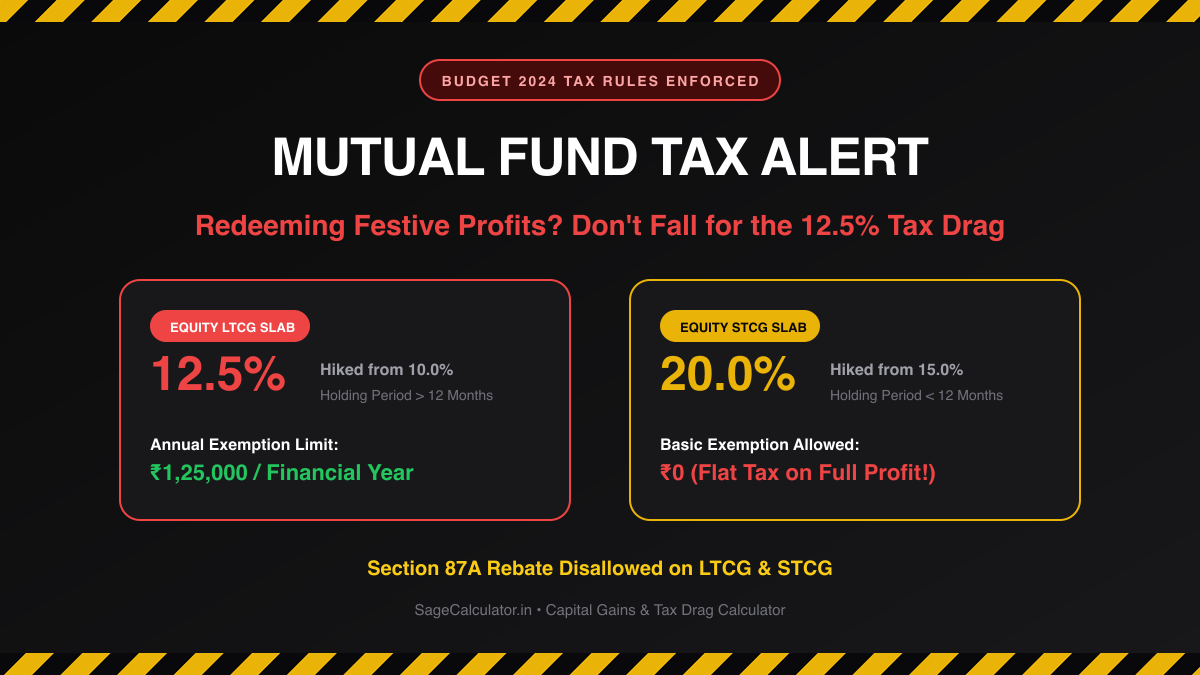
- Section 112A Long-Term Capital Gains (LTCG) on equity shares and equity mutual funds increased from 10% to 12.5%.
- The annual statutory LTCG tax exemption was raised marginally from ₹1,00,000 to ₹1,25,000 per financial year.
- Section 111A Short-Term Capital Gains (STCG) on units held for less than 12 months hiked from 15% to flat 20%.
- Section 87A rebate (tax-free up to ₹7 Lakhs) is NOT available against special rate capital gains under CPC demand rules.
Calculate Your Exact Mutual Fund LTCG & STCG Tax
Audit your redemptions across listed equities, equity mutual funds, and debt funds under revised Budget 2024–2026 tax slabs.
The Festive Redemption Surge: The New Tax Drag on Wealth
Late October is historically marked by heavy mutual fund redemptions across India as retail families liquidate investment gains to pay for festive shopping, home renovations, vehicle down payments, and gold jewelry.
However, FY 2026–27 redemptions fall under the revised capital gains framework introduced by the Finance (No. 2) Act 2024. Many casual investors mistakenly calculate tax based on legacy 10% LTCG and 15% STCG rates, leading to severe tax surprises during Advance Tax and ITR filing.
The Two Slabs Every Mutual Fund Investor Must Know
1. Long-Term Capital Gains (LTCG — Units Held > 12 Months): If you redeem equity mutual funds held for more than 365 days, gains up to ₹1,25,000 in the financial year are 100% tax-free. Any profit exceeding ₹1,25,000 is taxed at a flat 12.5% (plus 4% Health & Education Cess = 13.0%).
2. Short-Term Capital Gains (STCG — Units Held ≤ 12 Months): If you redeem units held for 365 days or fewer, there is ZERO basic exemption limit. Every single rupee of profit is taxed at a punitive flat 20% (effective 20.8% with cess).
| Gain Component | Old Tax Law (Pre-Budget 2024) | Current Statutory Law (FY 2026–27) | Extra Tax Drag |
|---|---|---|---|
| Total Equity LTCG Profit | ₹3,00,000 | ₹3,00,000 | ₹0 |
| Annual Exemption | ₹1,00,000 | ₹1,25,000 | +₹25,000 Shield |
| Taxable Capital Gain | ₹2,00,000 | ₹1,75,000 | -₹25,000 |
| Statutory Tax Rate | 10.0% | 12.5% | +2.5% Higher Rate |
| Base Tax Liability | ₹20,000 | ₹21,875 | +₹1,875 |
| Total Tax (with 4% Cess) | ₹20,800 | ₹22,750 | +₹1,950 Out of Pocket |
The Section 87A Trap: Why CPC Notices Disallow Rebate
A pervasive myth among salaried professionals is that if their total taxable income is below ₹7,00,000 under the New Tax Regime (Section 115BAC), they owe zero tax on capital gains.
The Income Tax Central Processing Centre (CPC) strictly interprets Section 112A and 111A as special rate taxes. The statutory rebate under Section 87A cannot be adjusted against special rate capital gains. Even if your regular salary is zero, an equity LTCG of ₹2,50,000 will generate an unavoidable tax demand of ₹16,250.
Frequently Asked Questions (FAQs)
Does the ₹1,25,000 LTCG exemption apply separately to each mutual fund scheme?▼
No. The ₹1,25,000 exemption is an aggregate annual ceiling across ALL listed shares and equity mutual funds redeemed during the entire financial year.
How are Debt Mutual Funds taxed upon redemption?▼
Under Section 50AA, debt mutual funds (with less than 35% equity exposure) acquired on or after April 1, 2023, do not qualify for LTCG rates or indexation benefits. All gains are treated as short-term and added directly to your taxable income at slab rates.
Can I harvest capital losses to reduce my mutual fund tax bill?▼
Yes. Long-term capital losses can be set off against long-term capital gains, while short-term capital losses can be set off against both short-term and long-term capital gains in the same assessment year.