Advance Tax 3rd Installment (Dec 15): Why Paying Under 75% Triggers 1% Monthly Interest Under Section 234C (Even on Capital Gains & Freelance Income)
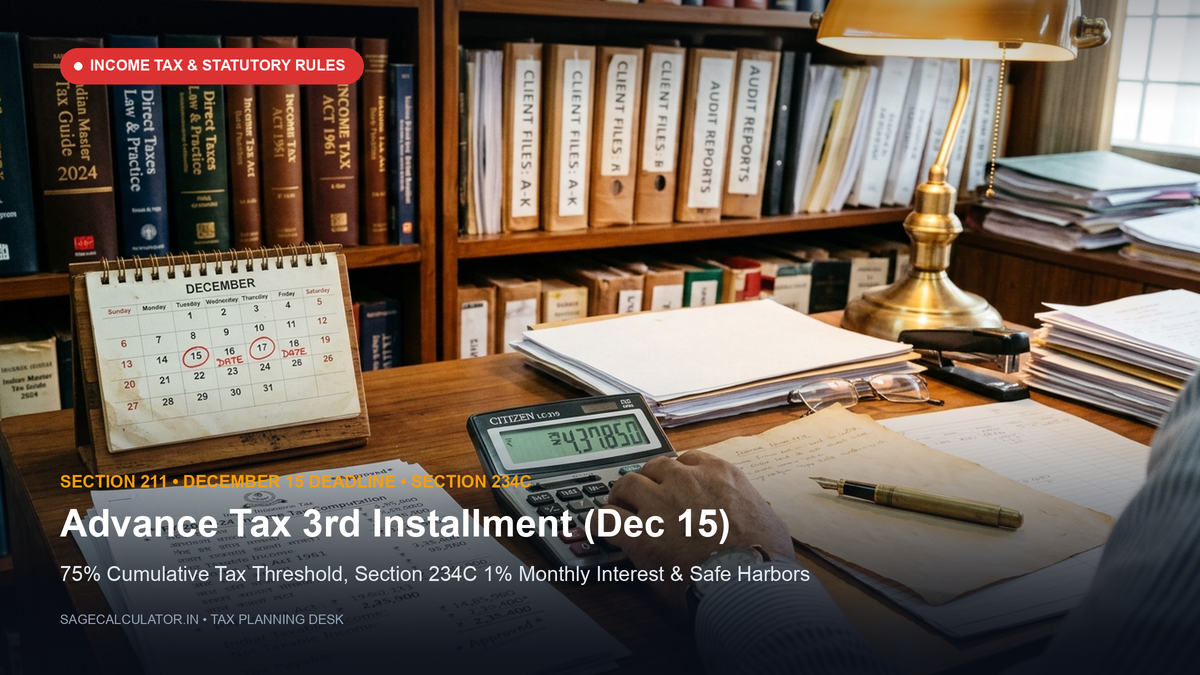
- December 15 marks the statutory 3rd installment deadline where taxpayers must have deposited at least 75% of their net estimated annual tax liability.
- Section 234C levies penal interest at 1% per month for a mandatory 3-month block (Shortfall × 1% × 3) on any deferment of the December 15 installment.
- Salaried employees are NOT automatically immune: if TDS deducted by your employer does not cover your capital gains, FD interest, or moonlighting income, advance tax is compulsory if net liability exceeds ₹10,000.
- The Proviso to Section 234C grants special immunity for unexpected capital gains, dividend income, or newly commenced business, provided full tax is cleared in the subsequent installment.
- Senior citizens aged 60 and above with no business or professional income are 100% exempt from paying advance tax under Section 207.
Calculate Your Exact Advance Tax Shortfall & Section 234C Interest
Enter your estimated annual income, capital gains, TDS already deducted, and installment payments to compute exact Section 234A, 234B, and 234C interest penalties.
The December 15 Milestone: Who is Required to Pay Advance Tax?
Under Section 208 of the Income-tax Act, 1961, every taxpayer whose estimated total tax liability for the financial year (after adjusting for TDS, TCS, and tax credits) equals or exceeds ₹10,000 is legally mandated to pay advance tax in four designated quarterly installments.
A widespread misconception among corporate salaried employees is that Advance Tax is only meant for traders, businessmen, or large corporate entities. However, if you earn supplemental income—such as capital gains from stock market or mutual fund sales, high-yield bank FD interest, rental income, or freelance consulting fees—and your employer has not deducted sufficient TDS under Section 192, you must independently calculate and deposit advance tax before each statutory cutoff.
For FY 2026–27 (Assessment Year 2027–28), December 15 represents the pivotal third installment milestone where the cumulative advance tax payment threshold jumps from 45% to 75%.
Official Advance Tax Installment Slabs & Statutory Schedule
The Income Tax Department enforces a progressive 4-installment schedule under Section 211 for all individual and corporate taxpayers (excluding presumptive taxpayers under Section 44AD/44ADA who pay 100% in a single installment by March 15):
| Installment Due Date | Cumulative Statutory Threshold | Section 234C Penalty Multiplier | Grace Allowance (Safe Harbor) |
|---|---|---|---|
| On or before June 15 | Not less than 15% of total tax | 1% per month for 3 months (3%) | No interest if at least 12% is paid |
| On or before September 15 | Not less than 45% of total tax | 1% per month for 3 months (3%) | No interest if at least 36% is paid |
| On or before December 15 | Not less than 75% of total tax | 1% per month for 3 months (3%) | Strict 75% threshold (No grace margin) |
| On or before March 15 | 100% of total tax liability | 1% for 1 month (1%) | Strict 100% threshold |
How Section 234C Interest is Calculated (Official Rules & Guidelines)
Section 234C is designed to penalize the deferment or deferral of quarterly installments. Unlike Section 234B (which assesses the overall year-end deficit starting April 1), Section 234C evaluates the exact deficit existing on each installment date.
For the December 15 installment, the statutory shortfall formula is:
Shortfall = (75% of Total Assessed Tax) – (TDS/TCS Credited) – (Advance Tax Paid on or before December 15)
If this resulting balance is greater than zero, interest is computed at the statutory simple rate of 1% per month (or fraction of a month) for a compulsory 3-month period. This means any unpaid balance on December 15 immediately incurs a flat 3% penalty multiplier.
Worked Example: Consider an individual with total net tax liability of ₹2,00,000 for FY 2026–27. By December 15, their cumulative advance tax obligation is 75% of ₹2,00,000 = ₹1,50,000. If they have only paid ₹90,000 across the first three quarters, their deficit is ₹60,000. The Section 234C interest levied is ₹60,000 × 1% × 3 months = ₹1,800.
The Capital Gains & Volatile Income Exception (The Legal Safe Harbor)
Many investors worry that booking unexpected capital gains during the festive Diwali rally or receiving unforeseen dividend income makes it impossible to accurately forecast tax back in June or September.
To protect taxpayers against arbitrary penalties, the first proviso to Section 234C(1) creates a statutory safe-harbor exemption. No Section 234C interest is levied on installment shortfalls caused by:
1. Capital gains arising from the sale of listed equities, mutual funds, or real estate.
2. Winnings from lotteries, crosswords, or horse races.
3. Income from a new business or profession established during the financial year.
4. Unexpected dividend payouts exceeding ₹10,000.
Condition for Immunity: To claim this statutory safe harbor, the taxpayer must pay the full tax payable on such unpredictable gains in the remaining advance tax installments that fall due after the date of receipt, or by March 31 of the financial year.
Step-by-Step Guide to Depositing Advance Tax via e-Pay Tax (Challan ITNS 280)
Paying advance tax takes under 5 minutes online through the Income Tax e-Filing Portal:
1. Visit incometax.gov.in and click on "e-Pay Tax" under Quick Links.
2. Enter your PAN/Aadhaar number and confirm via mobile OTP verification.
3. Select Tile 1: "Income Tax" and click Proceed.
4. Select Assessment Year as "AY 2027–28" (corresponding to Financial Year 2026–27). Selecting the wrong AY causes severe reconciliation delays!
5. Under Type of Payment (Minor Head), select "Advance Tax (100)". Do NOT select Self-Assessment Tax (300).
6. Enter the computed tax amount under the appropriate heads (Tax, Surcharge, 4% Health and Education Cess).
7. Complete payment via Net Banking, Debit Card, RTGS/NEFT, or UPI, and instantly download the PDF Challan containing the BSR Code and Challan Serial Number (CRN).
Direct Tax Advisory Head • SageCalculator Research Desk
Frequently Asked Questions (FAQs)
Can I adjust my December 15 advance tax shortfall by paying in January?▼
You can pay the pending tax in January, but doing so will NOT eliminate the Section 234C interest for the December 15 installment. Section 234C interest for the December 15 cutoff is fixed by statute for a full 3-month duration regardless of whether payment is made on January 5 or February 28.
Are senior citizens required to pay advance tax before December 15?▼
No. Under Section 207 of the Income-tax Act, a resident individual aged 60 years or above who does NOT have any income chargeable under the head "Profits and Gains of Business or Profession" is fully exempt from paying advance tax. They can pay their entire tax liability as Self-Assessment Tax without any interest penalty under Section 234B or 234C.
Does Section 234C apply if I opt for the New Tax Regime in FY 2026–27?▼
Yes. The obligation to pay advance tax under Section 208 and the levy of penal interest under Section 234C apply identically under both the New Tax Regime and the Old Tax Regime. The only difference is the tax slab rates used to compute your total estimated tax liability.
What is the safe harbor threshold for the June and September installments?▼
The law provides a minor relaxation: for the June 15 installment, interest is waived if at least 12% (instead of 15%) is paid. For September 15, interest is waived if at least 36% (instead of 45%) is paid. However, for December 15, there is NO percentage margin—you must pay the full 75%.
What happens if I miss the advance tax cutoff completely until March 31?▼
If your cumulative advance tax paid by March 31 falls below 90% of your total assessed tax, you will face two cumulative penalties starting April 1: Section 234B interest at 1% per month on the entire remaining deficit until the date of filing, in addition to all Section 234C quarterly deferment interest.