HRA Exemption in Bengaluru & Hyderabad (50% Ceiling) vs Gurgaon & Noida (40% Non-Metro Trap): How IT Professionals Can Save ₹48,000 in Tax
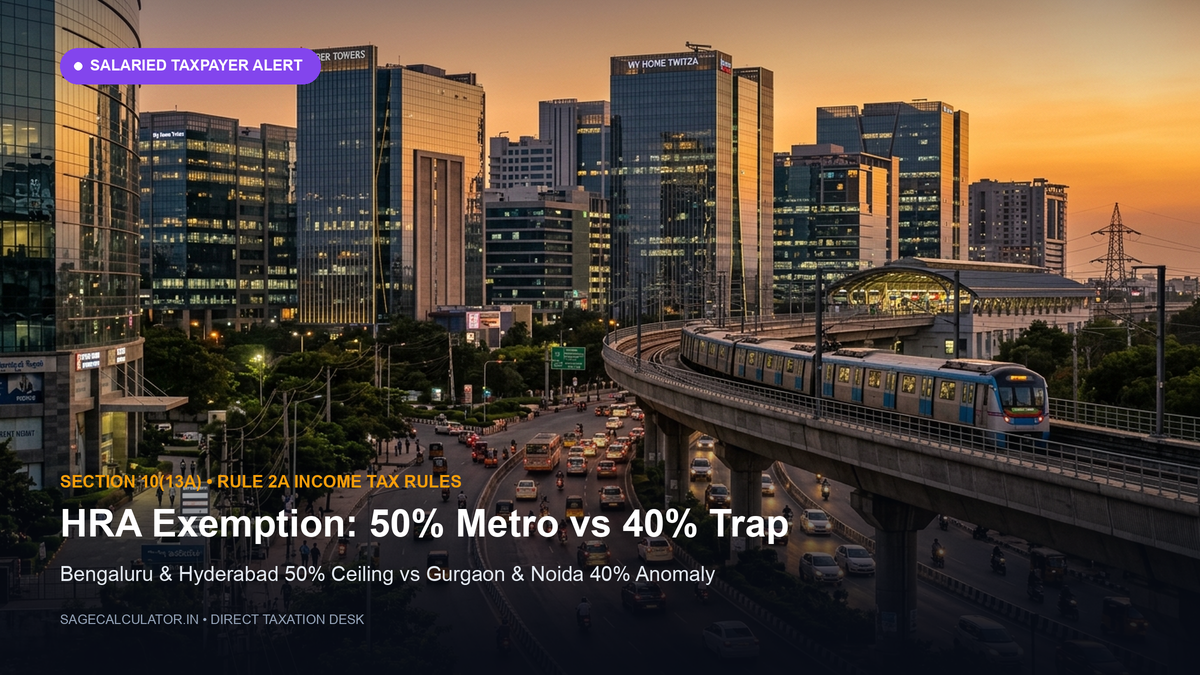
- Section 10(13A) Exemption Rule: HRA tax exemption under the Old Tax Regime is calculated as the lowest of: 1) Actual HRA received, 2) Rent paid minus 10% of basic salary, and 3) 50% of basic salary for metro cities or 40% for non-metro cities.
- Bengaluru & Hyderabad 50% Recognition: Major technology hubs (Bengaluru, Hyderabad, Pune, Ahmedabad) are officially categorized under the 50% metro allowance ceiling for FY 2026–27, eliminating decade-long tax disparities.
- The Gurgaon & Noida Anomaly: Despite commanding some of the highest residential rentals in India (₹40,000 to ₹75,000/month in DLF Phase 5 and Noida Expressway), satellite NCR cities remain legally classified as 40% non-metros under Rule 2A.
- The ₹48,000 Tax Difference: A tech lead earning ₹15 Lakhs Basic Pay paying ₹45,000/month rent receives ₹60,000 lower HRA exemption in Gurgaon than in Bengaluru, triggering up to ₹48,000 in extra annual income tax!
- Landlord PAN Compliance: Submitting landlord PAN is mandatory under CBDT Circular 08/2013 if total annual rent paid exceeds ₹1,00,000 (i.e. >₹8,333/month). If the landlord refuses to share PAN, the employer must deduct 20% penal TDS or disallow HRA.
Calculate Your HRA Tax Exemption (Metro vs Non-Metro)
Compare your exact Section 10(13A) tax exemption across Metro (50%) and Non-Metro (40%) tiers instantly.
The Urban Rental Crisis: Why HRA Classification Matters to Salaried IT Employees
In major Indian technology hubs, residential rents have surged by 40% to 65% over the past three years. For senior developers, engineering managers, and product leads paying ₹40,000 to ₹70,000 monthly for a 3BHK near tech parks, House Rent Allowance (HRA) is the single most valuable tax shield under the Old Tax Regime.
Under Section 10(13A) of the Income-tax Act, 1961 read with Rule 2A of the Income-tax Rules, 1962, the tax exemption on HRA is strictly governed by whether the accommodation is situated in a "Metro" or "Non-Metro" city.
Historically, Rule 2A recognized only four cities as metros: Mumbai, Delhi, Kolkata, and Chennai. Salaried employees in Bengaluru, Hyderabad, and Pune paid identical or higher rents but were capped at the lower 40% threshold.
While recent statutory policy updates recognized Bengaluru, Hyderabad, and Pune under the 50% ceiling, an unexpected geographic trap emerged for Delhi-NCR: Gurgaon (Gurugram) and Noida remain classified as 40% non-metro cities because they fall in Haryana and Uttar Pradesh!
How Section 10(13A) Works (The 3-Limb Statutory Formula)
Under statutory rules, your exempt HRA is calculated as the LEAST of the following three amounts:
• Limb 1: Actual House Rent Allowance received from your employer during the financial year.
• Limb 2: Actual Rent Paid minus 10% of Basic Salary (+ DA if forming part of superannuation benefits).
• Limb 3: 50% of Basic Salary (if living in a recognized Metro) OR 40% of Basic Salary (if living in any other city).
Whichever amount is lowest is exempt from income tax; the remaining balance of HRA received is added to your gross taxable salary.
| Calculation Parameter | Bengaluru / Hyderabad (50% Metro) | Gurgaon / Noida (40% Non-Metro) | Discrepancy / Tax Impact |
|---|---|---|---|
| Annual Basic Pay | ₹15,00,000 | ₹15,00,000 | Identical CTC |
| Actual HRA Received from Employer | ₹6,00,000 (40% of Basic) | ₹6,00,000 (40% of Basic) | Identical Allowance |
| Annual Rent Paid (₹45,000/month) | ₹5,40,000 | ₹5,40,000 | Identical Rent Outgo |
| Limb 1: Actual HRA Received | ₹6,00,000 | ₹6,00,000 | Identical |
| Limb 2: Rent Paid - 10% Basic | ₹5,40,000 - ₹1,50,000 = ₹3,90,000 | ₹5,40,000 - ₹1,50,000 = ₹3,90,000 | Identical |
| Limb 3: City Percentage Cap | 50% of Basic = ₹7,50,000 | 40% of Basic = ₹6,00,000 | Bengaluru gets ₹1.5L higher ceiling |
| Total Exempt HRA (Least of 3) | ₹3,90,000 Exempt | ₹3,90,000 Exempt | Both hit Limb 2 constraint |
| Scenario B: High Rent (₹65,000/mo = ₹7.8L) | ₹6,00,000 100% Tax-Free! | Only ₹5,40,000 Tax-Free (Capped at 40%) | ₹60,000 Extra Taxable Income in Gurgaon! |
Why Renting in Gurgaon or Noida Penalizes High-Earning Salaried Staff
In Scenario B above (a family renting a 3BHK or 4BHK in Gurgaon Golf Course Road or Noida Sector 128 for ₹65,000/month):
• In Bengaluru or Hyderabad: Limb 2 gives Rent Paid (₹7,80,000) minus 10% Basic (₹1,50,000) = ₹6,30,000. Because the metro ceiling is 50% (₹7,50,000), the employee successfully claims the FULL ₹6,00,000 HRA tax-free!
• In Gurgaon or Noida: Even though the employee pays the same ₹7,80,000 rent, Limb 3 caps their exemption at 40% of Basic = ₹6,00,000. The employee loses ₹60,000 in deductions, triggering up to ₹18,720 to ₹20,592 in extra income tax (at 30% slab + 4% cess)!
This geographical disparity has led corporate HR heads and tax federations across Gurgaon and Noida to lobby the CBDT to extend the 50% metro status to the entire National Capital Region (NCR).
Landlord PAN Mandate & The 20% Penal TDS Trap
Under CBDT Circular No. 08/2013, if the annual rent paid by an employee exceeds ₹1,00,000 (which translates to just ₹8,334 per month), the employee MUST report the Permanent Account Number (PAN) of the landlord to their employer payroll team.
Critical compliance rules to avoid rejection:
1. Landlord Without PAN: If your landlord does not have a PAN, you must obtain a signed declaration in Form 60 along with their identification proof.
2. Inoperative / Non-Linked PAN: If the landlord’s PAN is inoperative due to failure to link Aadhaar, payroll software will flag the PAN as invalid.
3. Section 194-IB TDS on Rent: If you pay more than ₹50,000 per month rent to a resident landlord, you are legally required to deduct 2% TDS under Section 194-IB (slashed from 5% in Budget 2024) once a year using Form 26QC, regardless of whether you claim HRA!
Taxation & Employee Benefits Desk • SageCalculator Research Desk
Frequently Asked Questions (FAQs)
Can I claim HRA exemption if I live with my parents and pay them rent?▼
Yes! You can legally pay rent to your parents and claim HRA exemption under Section 10(13A), provided your parents legally own the property, you make monthly bank transfers, and your parents declare the rental income in their respective Income Tax Returns (ITR).
Can I claim both HRA exemption and Home Loan tax deduction under Section 24(b)?▼
Yes, if you own a home in one city (or far from your workplace) and are forced to live in rented accommodation near your employment location due to genuine professional necessity, you can claim HRA for rent paid AND deduction on home loan interest under Section 24(b) up to ₹2,00,000.
Is HRA exemption available under the New Tax Regime (Section 115BAC)?▼
No. HRA exemption is strictly an Old Tax Regime deduction. If you choose the New Tax Regime, your entire HRA is included in your gross salary and taxed at standard slab rates (though you benefit from lower tax slabs and a ₹75,000 standard deduction).
What documents are required to claim HRA through my employer?▼
You must submit a valid registered or notarized Rent Agreement, monthly rent receipts with revenue stamps (for cash payments) or bank transfer records, and the Landlord’s PAN copy if annual rent exceeds ₹1,00,000.