
NPS Vatsalya vs Sukanya Samriddhi vs Minor Mutual Fund SIP: Where Should Parents Invest for Their Child’s 18th Birthday?
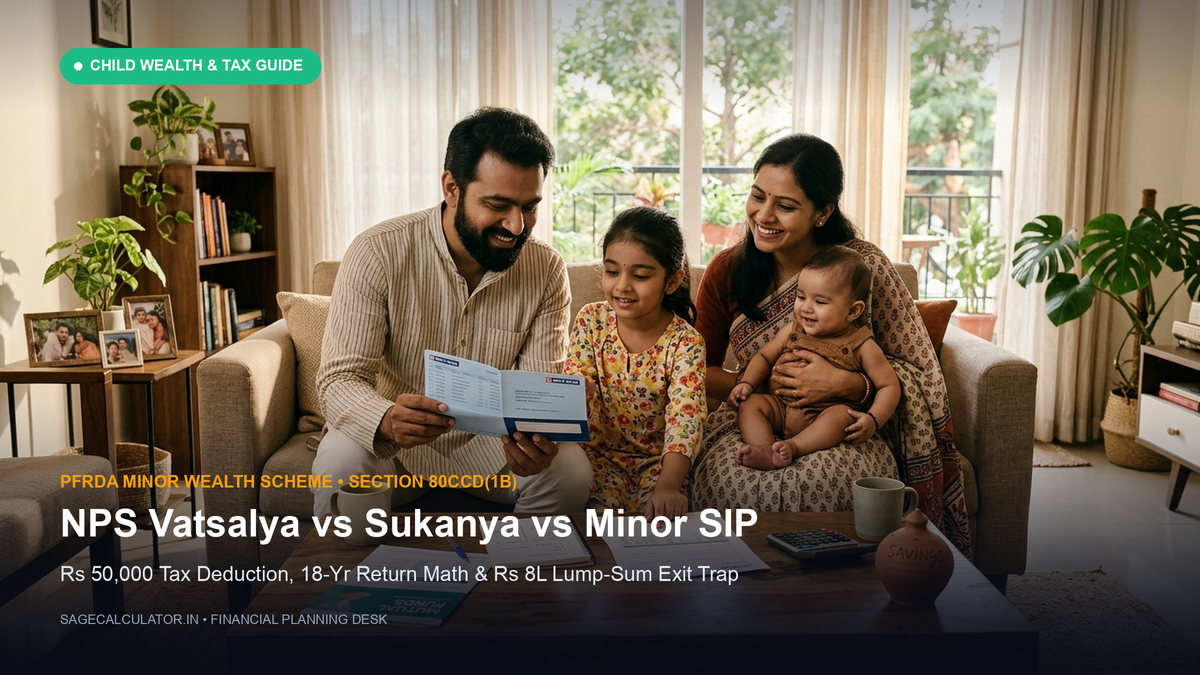
- NPS Vatsalya allows any Indian parent/guardian to open a regulated pension account for minor children (boys and girls under 18) with a minimum annual contribution of just ₹1,000.
- Parents opting for the Old Tax Regime can claim an additional tax deduction of up to ₹50,000 per financial year under Section 80CCD(1B) for NPS Vatsalya contributions.
- Sukanya Samriddhi Yojana (SSY) guarantees 8.20% sovereign tax-free returns under EEE status, but is legally restricted to girl children up to age 10 with a ₹1.5 Lakh annual ceiling.
- The Age 18 Transition Rule: At age 18, NPS Vatsalya converts to standard NPS Tier-1. If the accumulated corpus is ₹8 Lakhs or below, 100% can be withdrawn as a tax-free lump sum; above ₹8 Lakhs, a minimum 80% must buy an annuity unless continued to age 60.
- 18-Year Compounding Math: Depositing ₹5,000/month (₹60,000/yr) from birth yields ~₹36.8 Lakhs in SSY (at 8.20% p.a.) vs ~₹58.2 Lakhs in NPS Vatsalya (at 11% p.a. 75:25 equity blend) vs ~₹66.7 Lakhs in a diversified Minor Equity SIP (at 12% p.a.).
Calculate Your Child’s Sukanya Samriddhi Corpus
Project official 8.20% compound interest, 15-year deposit schedules, and 21-year tax-free maturity payouts.
The New Paradigm: Systematic Wealth Creation for Minors in India
For decades, Indian parents seeking structured, long-term savings for their children were limited to traditional bank Fixed Deposits, sovereign gold schemes, or LIC child policies offering real returns often lagging education inflation.
While the Sukanya Samriddhi Yojana (SSY) transformed financial security for daughters with its sovereign 8.20% tax-free compounding, parents of boys—or parents seeking equity market participation for their daughters—had no dedicated sovereign vehicle.
The Pension Fund Regulatory and Development Authority (PFRDA) bridged this gap through NPS Vatsalya. Operating under the National Pension System architecture, it provides minors under 18 with a Permanent Retirement Account Number (PRAN) managed by guardians, combining low costs, institutional fund management, and up to 75% equity allocation.
How the 3 Instruments Compare (Eligibility, Returns & Tax Rules)
Choosing the right wealth vehicle depends on your child’s gender, your risk tolerance, and whether you file taxes under the Old or New Tax Regime:
• Sukanya Samriddhi Yojana (SSY): Restricted to girl children below 10 years of age. Operates under the Exempt-Exempt-Exempt (EEE) tax regime. The 8.20% p.a. sovereign interest is backed by the Government of India and revised quarterly by the Ministry of Finance. Annual deposits are capped at ₹1.5 Lakhs.
• NPS Vatsalya: Open to ALL minor Indian citizens (boys and girls under 18). Offers flexible asset allocation: Active Choice allows up to 75% equity (Asset Class E), Corporate Debt (Class C), and Govt Bonds (Class G), while Auto Choice offers lifecycle lifecycle matrices. Minimum annual deposit is ₹1,000 with no upper ceiling.
• Minor Mutual Fund Equity SIP: Open to all minors via a guardian. Offers 100% equity exposure with top active or passive index funds. Long-Term Capital Gains (LTCG) above ₹1.25 Lakhs per financial year are taxed at 12.5% under Section 112A without indexation.
| Parameter | Sukanya Samriddhi (SSY) | NPS Vatsalya | Minor Mutual Fund SIP |
|---|---|---|---|
| Eligible Child | Girl Child Only (Age < 10 yrs) | All Minors (Boys & Girls < 18 yrs) | All Minors (Boys & Girls < 18 yrs) |
| Sovereign Guarantee | 100% Govt of India Guaranteed | Market-Linked (PFRDA Regulated) | Market-Linked (SEBI Regulated) |
| Historical / Expected Return | 8.20% p.a. (Fixed Sovereign) | 10.5% – 11.5% p.a. (75% Equity) | 12.0% – 13.5% p.a. (100% Equity) |
| Parent Tax Deduction | Sec 80C (up to ₹1.5L, Old Regime) | Sec 80CCD(1B) (up to ₹50k, Old Regime) | Nil (No tax deduction) |
| Maturity Tax Status | 100% Tax-Free (EEE Status) | Tax-Efficient (Tier-1 Rules) | 12.5% LTCG above ₹1.25 Lakhs |
| Liquidity Before Age 18 | 50% at Age 18 (Higher Education) | 25% of own deposits (Max 3 times) | Full Liquidity (Guardian authorized) |
| Exit Options at Age 18 | Matures at 21 yrs or marriage | Lump Sum if ≤ ₹8L; Else 80% Annuity | 100% Unrestricted Redemption |
The ₹8 Lakh Exit Trap: What Happens When Your Child Turns 18?
The most critical regulatory detail parents must understand before opening an NPS Vatsalya account is the Age 18 Exit Provision codified by PFRDA:
1. Seamless Conversion to Standard NPS Tier-1: On attaining the age of 18, the minor completes fresh KYC and takes full individual ownership of the PRAN account. The account transitions automatically to an all-citizen Tier-1 account.
2. The ₹8 Lakh Lump-Sum Threshold: If the total accumulated corpus at age 18 is ₹8,00,000 or less, the young adult has the legal right to withdraw 100% of the corpus as a lump sum without purchasing any annuity.
3. The Annuity Restriction (> ₹8 Lakhs): If your systematic investments compound beyond ₹8,00,000, standard NPS premature exit rules apply if you choose to exit. A minimum of 80% of the corpus must be utilized to purchase an immediate annuity from an IRDAI-registered life insurance company, with only 20% available as a lump sum!
4. The Smart Strategy: Because forced annuitization at age 18 yielding ~6% annuity rates is suboptimal for university tuition, parents should continue the NPS account as a retirement baseline (which allows 60% tax-free lump sum at age 60) while keeping higher-education funds in SSY or Mutual Fund SIPs.
18-Year Wealth Math: ₹5,000/Month Invested Across All 3 Options
To illustrate real-world compounding, consider an Indian parent investing ₹5,000 per month (₹60,000 annually, totaling ₹10,80,000 principal invested over 18 years):
• Sukanya Samriddhi Yojana (at 8.20% Sovereign Interest): Principal of ₹10.80 Lakhs compounds into ~₹36,82,000 completely tax-free. Every single rupee is backed by the sovereign faith of the Government of India.
• NPS Vatsalya (at 11.0% Blended Equity-Debt Return): Principal of ₹10.80 Lakhs compounds into ~₹58,24,000—delivering over ₹21.4 Lakhs in extra wealth compared to SSY due to the equity risk premium.
• Minor Mutual Fund Equity SIP (at 12.5% Equity CAGR): Principal of ₹10.80 Lakhs compounds into ~₹71,35,000. Even after deducting 12.5% LTCG tax on redemption, the post-tax corpus exceeds ~₹64.5 Lakhs with 100% liquid flexibility for university abroad.
Fixed Income & Wealth Desk • SageCalculator Research Desk
Frequently Asked Questions (FAQs)
Can parents claim a tax deduction for NPS Vatsalya contributions under the New Tax Regime?▼
No. Deductions under Section 80CCD(1B) up to ₹50,000 are available exclusively to taxpayers filing under the Old Tax Regime. Under the New Tax Regime (Section 115BAC), only employer corporate NPS contributions under Section 80CCD(2) are deductible.
Can an NRI parent open an NPS Vatsalya account for their child?▼
Yes. Non-Resident Indian (NRI) and Overseas Citizen of India (OCI) parents can open an NPS Vatsalya account for a minor child, provided contributions are remitted from an NRE or NRO banking account in accordance with RBI and FEMA guidelines.
Can a parent open both a Sukanya Samriddhi account and an NPS Vatsalya account for the same daughter?▼
Yes. There is no legal restriction against having both accounts. In fact, many financial planners recommend putting ₹1.5 Lakhs annually into SSY for guaranteed tax-free debt safety, and depositing additional savings into NPS Vatsalya for high-equity compounding.
What documents are required to open an NPS Vatsalya account?▼
You need the minor’s Date of Birth proof (Birth Certificate or Passport), the guardian’s KYC documents (Aadhaar and PAN card), and the guardian’s active bank account details for mandate linkage.