Cabinet Clears 53% DA Hike Ahead of Diwali: Check Exact 3-Month Arrears Credited in Your October 2026 Salary Slip
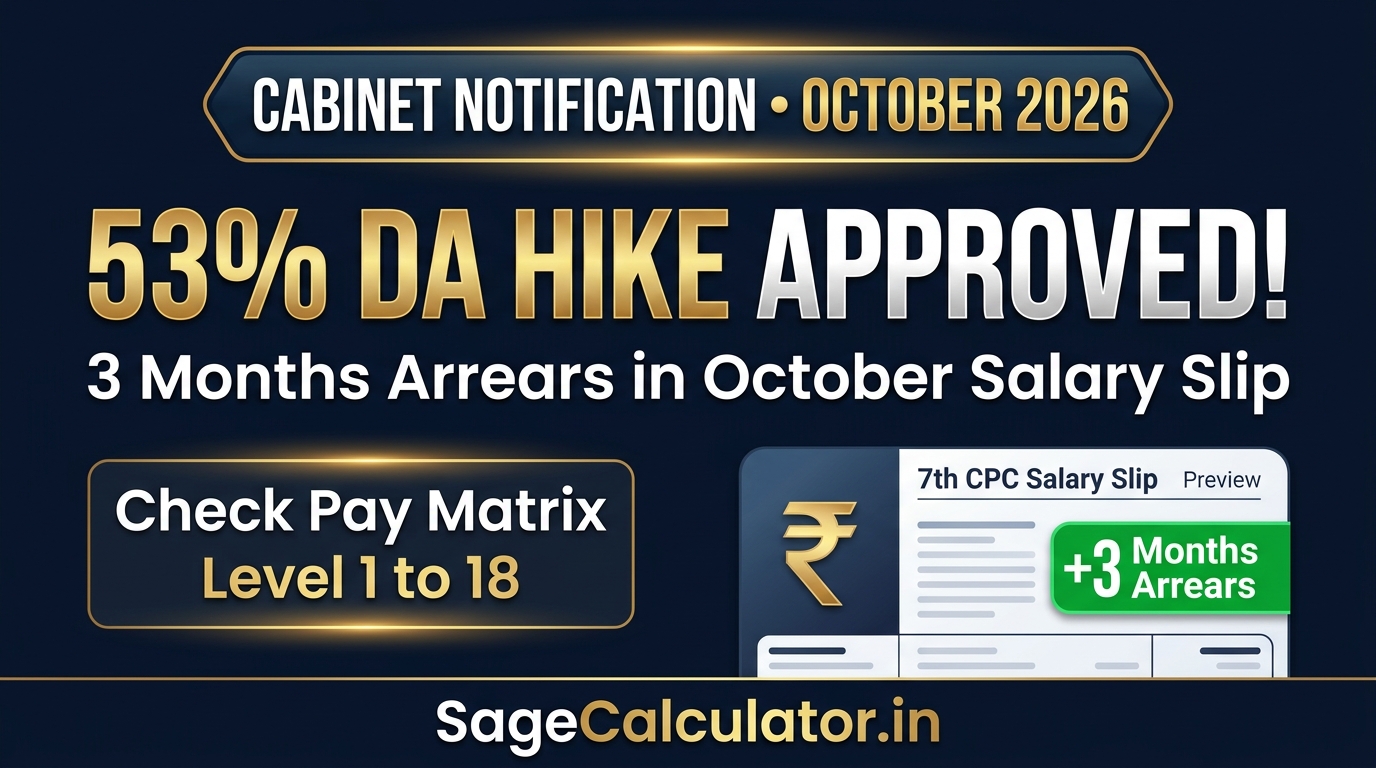
- DA rate officially increased by 3%, jumping from 50% to 53% effective retroactively from July 1, 2026.
- Employees and pensioners will receive a lump sum of 3 months arrears (July, August, and September) credited directly with their October salary.
- Transport Allowance (TA) and Dearness Allowance on TA (DA on TA) also index upwards automatically.
- HRA remains stable at the elevated 30% (X), 20% (Y), and 10% (Z) slabs which were triggered when DA crossed 50%.
Calculate Your October DA Arrears & Revised Pay
Input your 7th CPC Pay Matrix Level (1 to 18) and city tier to calculate your exact retroactive arrears and monthly take-home gain.
Diwali Festive Bonanza: What the 3% DA Hike Means for Your Take-Home Pay
In a welcome move ahead of the festive Diwali weekend, the Union Cabinet chaired by the Prime Minister has cleared the long-anticipated 3 percentage point hike in Dearness Allowance (DA) for central government employees and Dearness Relief (DR) for central civil and defence pensioners.
With this revision, the effective DA rate jumps from 50% to 53% of basic pay. Because the notification takes effect retroactively from July 1, 2026, the October 2026 salary disbursement will bundle the revised monthly DA along with three months of retrospective arrears spanning July, August, and September.
Crucially, Dearness Allowance is exempt from any wage ceilings—it is calculated deterministically on an employee’s running 7th CPC Basic Pay under the standard formula: DA = Basic Pay × Effective Percentage.
Estimated 3-Month Arrears Across 7th CPC Pay Matrix Levels
The table below summarizes the net 3-month arrears (July–September) and the ongoing monthly hike across key representative basic pay levels under the 7th Central Pay Commission:
| 7th CPC Level | Basic Pay | Old DA (50%) | New DA (53%) | Monthly Gain | Total 3-Month Arrears |
|---|---|---|---|---|---|
| Level 1 (Entry) | ₹18,000 | ₹9,000 | ₹9,540 | +₹540 / mo | ₹1,620 |
| Level 4 (LDC / Clerk) | ₹25,500 | ₹12,750 | ₹13,515 | +₹765 / mo | ₹2,295 |
| Level 7 (Inspector / ASO) | ₹44,900 | ₹22,450 | ₹23,797 | +₹1,347 / mo | ₹4,041 |
| Level 10 (Group A Entry) | ₹56,100 | ₹28,050 | ₹29,733 | +₹1,683 / mo | ₹5,049 |
| Level 12 (Under Secretary) | ₹78,800 | ₹39,400 | ₹41,764 | +₹2,364 / mo | ₹7,092 |
| Level 14 (Joint Secretary) | ₹1,44,200 | ₹72,100 | ₹76,426 | +₹4,326 / mo | ₹12,978 |
Does the 53% DA Rate Trigger Another HRA Hike?
A common point of confusion among government employees is whether crossing 53% triggers another automatic upward revision of House Rent Allowance (HRA).
Under the recommendations of the 7th Central Pay Commission, HRA rates were pegged to trigger automatic hikes at two specific thresholds: when DA reached 25% (HRA rose to 27%, 18%, 9%), and when DA reached 50% earlier in 2024 (HRA rose to 30% for X-cities, 20% for Y-cities, and 10% for Z-cities).
Because the 50% threshold was the final statutory trigger under 7th CPC guidelines, crossing 53% does not automatically increase HRA percentages further. HRA continues to be disbursed at 30%, 20%, and 10% of basic pay. Any further structural revision in allowances will now be evaluated under the upcoming 8th Central Pay Commission terms of reference.
Impact on Transport Allowance (TPTA) and Dearness Relief for Pensioners
Transport Allowance (TA) is not a static allowance; it is indexed with Dearness Allowance through the statutory formula: Total TA = Base TA + (Base TA × DA Rate).
For employees posted in Higher TPTA cities (such as Delhi, Mumbai, Bengaluru, Hyderabad, and Kolkata), base TA ranges from ₹1,350 to ₹7,200 depending on Pay Level. With DA at 53%, an employee drawing a base TA of ₹7,200 will now receive ₹7,200 + ₹3,816 = ₹11,016 per month as Transport Allowance.
For central civil, railway, and defence pensioners, Dearness Relief (DR) matches the 53% rate identically. DR is calculated on unreduced basic pension before commutation deductions, providing vital inflation insulation for senior retirees.
Frequently Asked Questions (FAQs)
When will the 53% DA and 3-month arrears be credited into bank accounts?▼
Central government departments, defence payrolls, and nationalized pension disbursing banks are instructed to credit the revised 53% DA and all 3 months of arrears (July, August, September) with the regular October 2026 salary and pension disbursement before the Diwali weekend.
Is the 3-month DA arrears amount subject to income tax deduction (TDS)?▼
Yes. Dearness Allowance is fully taxable as regular salary income under Section 17(1) of the Income Tax Act. The arrears credited in October will be incorporated into your annual taxable salary, and TDS will be deducted proportionately across remaining months of FY 2026–27.
Do autonomous bodies and state government employees get this hike immediately?▼
The Union Cabinet order applies directly to Central Government employees, defence personnel, and central pensioners. State governments (e.g., Maharashtra, Karnataka, Uttar Pradesh) and autonomous institutions typically issue matching state notifications within 2 to 6 weeks following the central announcement.
How is DA calculated for pensioners who have commuted 40% of their pension?▼
Under CCS (Commutation of Pension) Rules 1981, Dearness Relief (DR) is always calculated on your FULL unreduced basic pension, not on your commuted residual pension. Therefore, you receive the full 53% DR benefit regardless of commutation status.