8th Pay Commission Memorandum Submitted: How a 2.86x Fitment Factor Will Multiply Level 1 to 18 Basic Pay (Check Proposed Matrix)
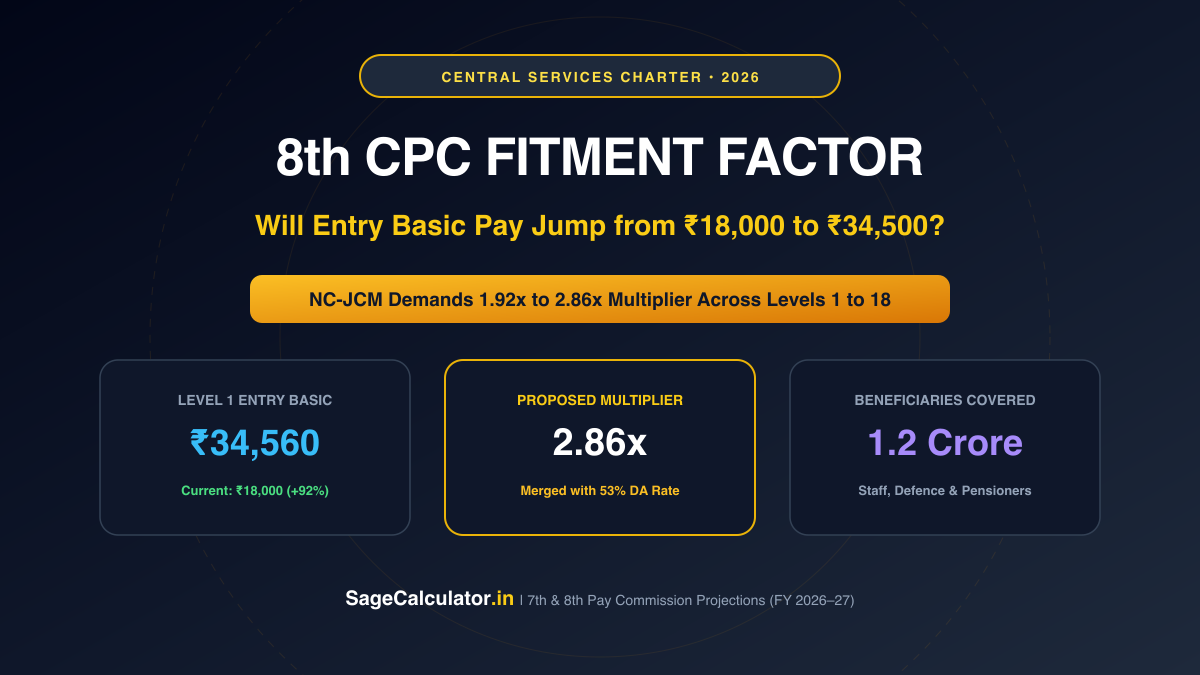
- Joint Consultative Machinery (NC-JCM) submitted charter for 8th CPC terms of reference.
- Demanded fitment factor ranges from 1.92x (conservative DA merger) to 2.86x (Aykroyd nutritional formula).
- Under a 1.92x factor, Level 1 basic rises to ₹34,560; under 2.86x, entry basic scales up to ₹51,480.
- Over 1.2 crore serving personnel and civil/defence pensioners would be impacted across all 18 pay matrix levels.
Simulate Your 8th CPC Salary & Fitment Factor Matrix
Test fitment factors from 1.83x to 4.0x across Pay Levels 1 to 18 to project revised basic, DA merger, and HRA allowances.
Why the 8th Pay Commission Clamour Has Reached Boiling Point
In India, Central Pay Commissions are constituted once every decade to revise basic salary structures, pension baselines, and allowance entitlements for over 49 lakh central government employees and nearly 68 lakh pensioners.
With the 7th Central Pay Commission having taken effect on January 1, 2016, and Dearness Allowance having crossed the landmark 50% milestone (reaching 53% in late 2024), staff unions argue that a comprehensive pay review is statutorily due by January 1, 2026.
The National Council of the Joint Consultative Machinery (NC-JCM) has submitted an exhaustive memorandum to the Cabinet Secretary and the Department of Expenditure, formally urging the government to announce the 8th CPC terms of reference.
The Math of the Fitment Factor: How Basic Pay is Multiplied
The "fitment factor" is the uniform numerical multiplier applied to existing basic pay to calculate revised entry compensation under a new pay commission. For instance, the 7th CPC utilized a 2.57x fitment factor, which raised the minimum basic pay from ₹7,000 (6th CPC) to ₹18,000.
In the 8th CPC memorandum, staff associations have presented two primary computational models:
1. The Conservative 1.92x Model: Takes the 53% existing DA, factors in estimated interim inflation up to 60%, and adds an 20% real wage enhancement: (1 + 0.60) × 1.20 = 1.92x. This elevates Level 1 entry pay to ₹34,560 per month.
2. The Wallace Aykroyd Minimum Living Wage 2.86x Model: Evaluates raw nutritional, clothing, and housing price indexes for a 3-member dependent family, yielding a proposed minimum basic pay of ₹51,480.
| 7th CPC Pay Level | Current Basic Pay | 1.92x Multiplier | 2.57x Factor | 2.86x Factor (Demanded) |
|---|---|---|---|---|
| Level 1 (MTS / Peon) | ₹18,000 | ₹34,560 | ₹46,260 | ₹51,480 |
| Level 4 (LDC / Clerk) | ₹25,500 | ₹48,960 | ₹65,535 | ₹72,930 |
| Level 7 (Inspector / ASO) | ₹44,900 | ₹86,208 | ₹1,15,393 | ₹1,28,414 |
| Level 10 (Group A Officer) | ₹56,100 | ₹1,07,712 | ₹1,44,177 | ₹1,60,446 |
| Level 12 (Under Secretary) | ₹78,800 | ₹1,51,296 | ₹2,02,516 | ₹2,25,368 |
| Level 14 (Joint Secretary) | ₹1,44,200 | ₹2,76,864 | ₹3,70,594 | ₹4,12,412 |
What Happens to Dearness Allowance Upon Constitution?
Whenever a new Pay Commission is instituted, Dearness Allowance is traditionally reset to 0%. The accumulated DA (currently 53%) is fully absorbed and merged into the new basic pay structure.
Consequently, pension commutations, gratuity caps (enhanced to ₹25 Lakhs under 7th CPC), and future annual 3% increments will compound from a significantly higher basic floor.
Frequently Asked Questions (FAQs)
Has the Central Government officially notified the 8th Pay Commission yet?▼
The Union Government has acknowledged receipt of representations from staff federations. While formal Terms of Reference (ToR) are pending cabinet approval, pay commissions typically take 18–24 months to draft recommendations and are traditionally given retrospective effect.
Will pensioners also benefit from the 8th CPC fitment factor?▼
Yes. Pension revisions under Pay Commissions apply equally to Central Civil, Railway, Postal, and Defence pensioners. Basic pension is multiplied by the approved fitment factor, resetting Dearness Relief (DR) to zero.
Will House Rent Allowance (HRA) increase under 8th CPC?▼
Under 7th CPC, HRA is currently pegged at 30% (X-cities), 20% (Y-cities), and 10% (Z-cities). While the percentages may be recalibrated, the actual rupee payout will nearly double because HRA is computed directly as a percentage of the enhanced basic pay.