
Carrying Gold Jewellery to India for Weddings: NRI Duty-Free Allowance Under Baggage Rules 2016, 20g vs 40g Limit, and Customs Valuation at Airport
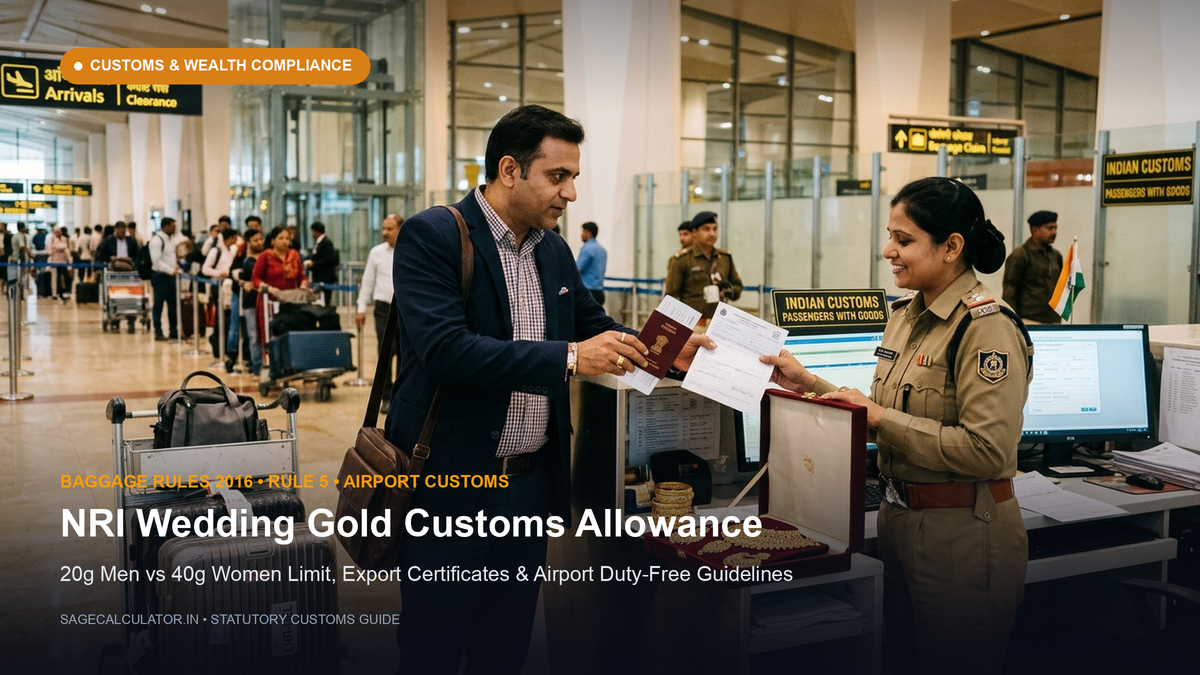
- Under Rule 5 of Baggage Rules 2016, duty-free gold jewellery allowance is restricted to passengers who have resided abroad for at least one full continuous year.
- Statutory limits: Male passengers can bring up to 20 grams of gold jewellery (capped at ₹50,000 value); Female passengers can bring up to 40 grams (capped at ₹1,00,000 value).
- The duty-free allowance applies strictly to personal gold JEWELLERY. Gold coins, bullion bars, biscuits, and ingots are NEVER duty-free and must always be declared at the Red Channel.
- Personal jewellery originally taken out from India can be brought back 100% duty-free without any weight limit, provided an Export Certificate was obtained at departure.
- Concealing gold or passing through the Green Channel with dutiable jewellery attracts severe penalties under Section 112 of the Customs Act, including outright confiscation.
Calculate 22K/24K Gold Rates, Making Charges & GST
Enter gold purity, weight in grams, jeweller making charge percentage, and 3% GST to calculate fair retail value before airport customs appraisal.
The Annual Winter Wedding Rush: Why Indian Airport Customs Scrutinizes Gold
Between November and February, international arrival terminals across Delhi, Mumbai, Bengaluru, Kochi, and Hyderabad witness peak passenger volumes as non-resident families return to India to attend or host family weddings.
Gold jewellery is a central element of Indian wedding ceremonies. However, India is one of the world’s largest importers of gold and enforces strict customs controls to curb unauthorized bullion inflows and revenue leakages.
Many travellers arrive under the false impression that personal ornaments worn on their body or packed in registered baggage are automatically immune from customs inspection. Under the Customs Act, 1962, all goods carried across international boundaries—including personal jewellery—fall under the jurisdiction of the Central Board of Indirect Taxes and Customs (CBIC).
Rule 5 of Baggage Rules 2016: The Statutory Duty-Free Allowance
Rule 5 of the Baggage Rules, 2016 explicitly sets forth the conditions and limits for duty-free clearance of gold jewellery carried by international passengers:
| Passenger Category | Permissible Weight Ceiling | Maximum Statutory Value Cap | Mandatory Minimum Overseas Stay |
|---|---|---|---|
| Gentlemen Passengers (Men/Boys) | 20 Grams | ₹50,000 Total Value | Over 1 year residence abroad |
| Lady Passengers (Women/Girls) | 40 Grams | ₹1,00,000 Total Value | Over 1 year residence abroad |
| Children (Accompanying) | Eligible per gender quotas | Same as above | Over 1 year residence abroad |
| Tourists / Short-Term Visitors | Zero Duty-Free Gold Allowance | Nil (Must pay customs duty) | Residing abroad under 1 year |
| Gold Coins / Bullion Bars | Zero Duty-Free Allowance (All passengers) | Nil (Dutiable from gram 1) | Not eligible under Baggage Rule 5 |
The Dual Trap: Weight Limit vs Rupee Value Ceiling
The most critical legal trap for NRIs is that the statutory allowance requires satisfying BOTH the weight limit AND the monetary value cap:
1. The Inflation Disconnect: The statutory value ceilings of ₹50,000 (for men) and ₹1,00,000 (for women) were codified when gold traded at roughly ₹25,000 to ₹30,000 per 10 grams. With 22-karat gold now trading near ₹75,000 to ₹80,000 per 10 grams, a lady passenger carrying 40 grams of gold owns jewellery valued well above ₹3,00,000.
2. Customs Appraisal Discretion: If the value exceeds the statutory rupee ceiling even though the weight is under 40 grams, customs officers technically possess the legal discretion to assess duty on the value differential.
3. Practical Airport Assessment: In practice, customs superintendents generally extend leeway to genuine worn personal jewellery within reasonable community customs, provided the items are visibly used ornaments rather than commercial quantities with price tags.
Bringing Back Ancestral & Already-Owned Jewellery: The Export Certificate Shield
If you are an Indian resident or an NRI who previously took personal or ancestral jewellery out of India and are now bringing it back, you do NOT have to pay any customs duty, provided you followed the formal departure protocol:
• Obtain an Export Certificate Prior to Departure: Before leaving India on your outbound flight, visit the Customs Appraisal Counter at the international airport (at least 2–3 hours before check-in).
• Physical Inspection & Valuation: The customs officer will inspect your ornaments, record the exact gross weight, purity, description, and photographs, and issue a formal stamped Customs Export Certificate.
• Re-Entry Immunity: This certificate is valid for multiple years. When returning to India, you simply present this document at the Red Channel. All listed jewellery is cleared 100% duty-free with zero questions or delays.
Red Channel vs Green Channel: How to Declare Excess Gold Without Penalties
If you are carrying jewellery or gold exceeding the statutory duty-free thresholds, follow these mandatory airport procedures:
1. Always Choose the Red Channel: Never attempt to walk through the Green Channel if you are carrying dutiable gold. Walking into the Green Channel with undeclared dutiable items constitutes a statutory offence under Section 77 of the Customs Act, exposing you to arrest, confiscation, and up to 100% penal fines.
2. Complete the Customs Declaration Form: Declare the exact weight, karat purity, and purchase invoices of all ornaments.
3. Eligible Concessional Customs Duty: Passengers who have resided abroad for more than 6 months are permitted to import up to 1 kilogram of gold upon payment of concessional customs duty in convertible foreign currency (subject to prevailing tariff notifications, typically 6% Basic Customs Duty + 10% Social Welfare Surcharge).
4. Payment Receipt: Retain the official Customs Duty Receipt (TR6 Challan) as permanent legal proof of legitimate import into India.
Direct Tax Advisory Head • SageCalculator Research Desk
Frequently Asked Questions (FAQs)
Can tourists on short vacation abroad bring back duty-free gold jewellery?▼
No. The duty-free gold allowance under Rule 5 of the Baggage Rules is strictly reserved for passengers who have resided abroad for more than one year. Indian tourists returning from a short 1-week or 1-month vacation in Dubai, Singapore, or Thailand are not eligible for any duty-free gold jewellery allowance and must pay customs duty on any gold purchased abroad.
Are gold coins, biscuits, or gold bars allowed under the duty-free baggage allowance?▼
No. Rule 5 of the Baggage Rules 2016 explicitly restricts the duty-free allowance to "jewellery". Gold coins, medallions, bullion bars, ingots, and biscuits are strictly excluded and cannot be cleared duty-free under any circumstances.
Can a husband combine his 20g quota with his wife’s 40g quota to bring one 60g necklace?▼
No. Customs baggage allowances are individual and non-transferable. A single piece of jewellery weighing 60 grams cannot be pooled across two passengers to claim exemption; duty will be assessed on the excess over the individual passenger’s quota.
What happens if customs officers seize gold at the airport?▼
If gold is undeclared in the Green Channel, it will be seized under Section 110 of the Customs Act. The passenger will receive a Seizure Memo and Show Cause Notice. To redeem the gold, the owner must pay the applicable customs duty, a redemption fine under Section 125, and a personal penalty under Section 112.
Do I need to carry original purchase invoices for jewellery bought abroad?▼
Yes. Carrying authentic retail purchase bills showing the hallmark, weight in grams, and itemized breakdown helps customs appraisers verify the valuation quickly. Without bills, customs officers will assess value based on prevailing CBIC tariff values.