Retiring in 2026? SCSS at 8.20% vs KVP Doubling in 115 Months: Where Should You Park Your ₹30 Lakh Gratuity?
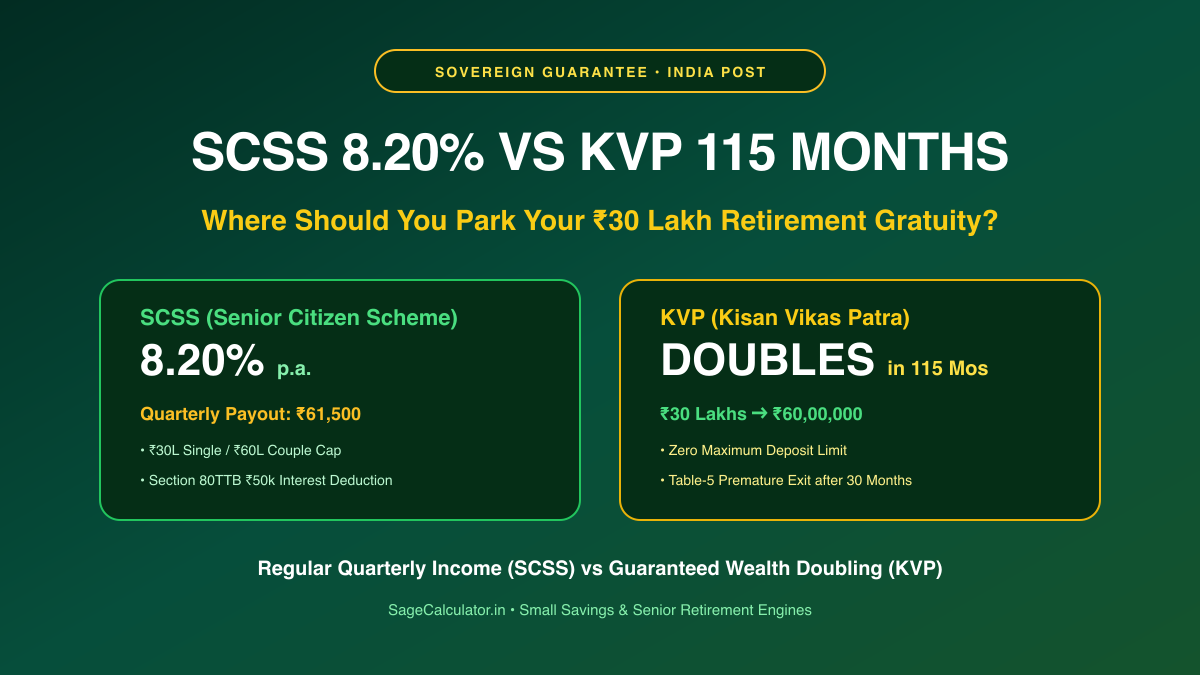
- Senior Citizen Savings Scheme (SCSS) offers an unmatched 8.20% p.a. sovereign rate with guaranteed quarterly pension payouts.
- The statutory individual ceiling for SCSS was enhanced to ₹30 Lakhs (₹60 Lakhs for married senior couples).
- Kisan Vikas Patra (KVP) doubles invested capital in exactly 115 months (9 years 7 months) at 7.50% annual compounding ($2 × P$).
- KVP has zero maximum investment limit and features statutory premature exit redemption schedules under Table-5 after 30 months.
Compare SCSS vs KVP Payouts for Your Lump Sum
Calculate quarterly interest, Section 80TTB ₹50k tax deductions, KVP doubling schedules, and Post Office exit factors.
The Sovereign Safe Haven Search for Retiring Professionals
Senior citizens concluding 30–35 years of service in government or private sectors receive substantial lump sums comprising gratuity, provident fund accumulations, and leave encashment.
With commercial bank fixed deposit rates expected to cool, locking in sovereign-guaranteed Ministry of Finance small savings rates is paramount. Two premier instruments dominate this space: the Senior Citizen Savings Scheme (SCSS) and Kisan Vikas Patra (KVP).
Regular Quarterly Income (SCSS) vs Sovereign Doubling (KVP)
While both schemes carry identical zero-default sovereign backing from the Government of India, their payout philosophies are polar opposites:
• SCSS is a Cashflow Engine: Designed for retirees who need predictable monthly/quarterly funds to cover living expenses, medical care, and utility bills. At 8.20% p.a., interest is deposited directly into your savings account on the first working day of April, July, October, and January.
• KVP is a Capital Growth Machine: Designed for senior citizens who have sufficient pension income and want to multiply their capital risk-free for children, grandchildren, or long-term estate planning. KVP reinvests every rupee of interest, doubling your principal in 9 years and 7 months.
| Metric / Feature | SCSS (Senior Citizen Scheme) | KVP (Kisan Vikas Patra) |
|---|---|---|
| Statutory Interest Rate | 8.20% per annum (Quarterly payout) | 7.50% per annum (Annual compounding) |
| Tenure Horizon | 5 Years (Extendable by 3 years) | 115 Months (9 Years 7 Months) |
| Payout Frequency | Quarterly (₹61,500 every 3 months) | Zero interim payout (100% at maturity) |
| Total Interest on ₹30L | ₹12,30,000 across 5 years | ₹30,00,000 (Principal DOUBLES) |
| Total Maturity Payout | ₹30,00,000 principal returned | ₹60,00,000 Guaranteed Sovereign Payout |
| Maximum Allowed Limit | ₹30 Lakhs per individual | Unlimited (No statutory upper cap) |
| Tax Benefit at Deposit | Section 80C deduction up to ₹1.5L | No Section 80C deduction |
| Interest Tax Deduction | Section 80TTB ₹50,000 deduction | Fully taxable at marginal slab rates |
The Ideal 50:50 Hybrid Retirement Allocation
Rather than choosing exclusively between SCSS and KVP, sophisticated financial planners recommend a balanced bifurcation for a ₹50–60 Lakh retirement kitty:
Place ₹30 Lakhs in SCSS to generate ₹2,46,000 in annual passive quarterly income (₹61,500/quarter) to fund healthcare and household expenses. Allocate the remaining surplus into KVP, allowing it to double untouched to fund long-term healthcare contingencies or inheritance.
Frequently Asked Questions (FAQs)
Can an individual below age 60 invest in SCSS?▼
Yes, under two specific statutory exceptions: retired defence personnel aged 50 or above, and civilian employees aged 55 to 60 who have opted for voluntary retirement (VRS), provided the deposit is made within 30 days of receiving retirement benefits.
Is TDS deducted on SCSS quarterly interest payouts?▼
Under Section 194A, if total annual SCSS interest exceeds ₹50,000, 10% TDS is deducted. Senior citizens with estimated total income below the taxable threshold can submit Form 15H to prevent TDS withholding.
Can KVP be closed before 115 months?▼
Yes. KVP has a statutory lock-in period of 30 months (2.5 years). After 30 months, premature encashment is permitted at any Post Office branch according to Ministry of Finance Gazette Table-5 predetermined redemption factors.