PPF 15-Year Maturity Rules: The 1-Year Form H Trap That Freezes Interest (Extension with Contribution vs Pure Compounding Explained)
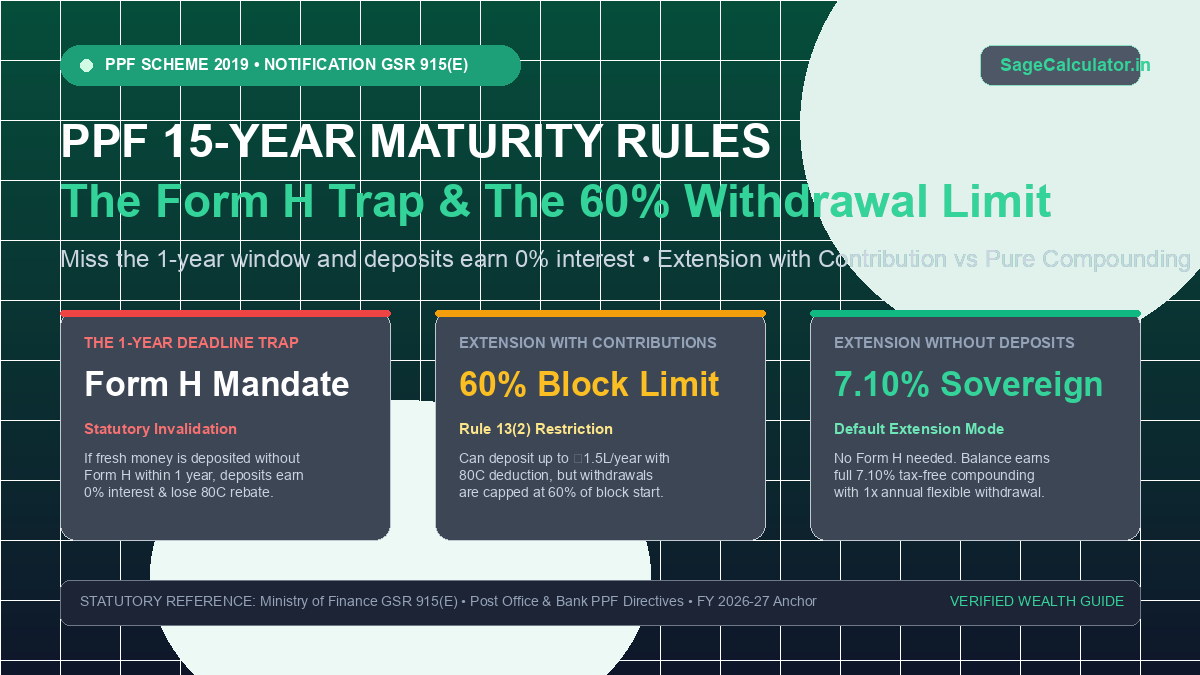
- Under the PPF Scheme 2019 (GSR 915(E)), the initial 15-year maturity actually spans 16 calendar years from the date of account opening.
- If continuing with fresh deposits, Form H MUST be submitted to your bank or Post Office within exactly 1 year of maturity.
- Deposits made after maturity without Form H are declared "irregular": they earn ZERO interest and forfeit Section 80C deductions.
- Extension with contributions caps total withdrawals across the 5-year block to a strict maximum of 60% of the balance at block commencement.
- Extension WITHOUT contributions requires zero paperwork, earns full 7.10% sovereign compounding, and allows one flexible withdrawal of any amount each fiscal year.
Simulate Your PPF 15-Year Maturity & Form H Extension Kitty
Project your 15-year maturity corpus, evaluate 5-year block extensions, check your 60% withdrawal limits, and compare returns with or without fresh contributions.
The 16-Calendar-Year Reality: How PPF Maturity is Formally Determined
The Public Provident Fund (PPF) remains India’s undisputed cornerstone of sovereign tax-free wealth creation, enjoying complete Exempt-Exempt-Exempt (EEE) status backed by the Ministry of Finance.
Yet one of the most widespread misconceptions among retail investors is the exact timing of maturity. While described colloquially as a "15-year scheme", Paragraph 13 of the Public Provident Fund Scheme, 2019 (promulgated under Gazette Notification GSR 915(E)) clarifies that an account matures after 15 complete financial years EXCLUDING the financial year in which the initial subscription was made.
For instance, if you opened your PPF account on 12 October 2010 (FY 2010-11), the initial year is counted as Year Zero. The 15 financial years begin on 1 April 2011 and mature on 31 March 2026—totalling 15 full years and nearly 6 months (spanning 16 calendar years).
The Three Post-Maturity Paths: Decision Matrix
Upon completing the statutory 15-year lock-in, account holders have three distinct legal pathways. Choosing the right path depends on your liquidity requirements, ongoing income tax planning, and retirement cashflow goals:
• Option 1: Complete Account Closure and Tax-Free Payout: Submit Form C at your bank branch or Post Office with the original passbook. The entire corpus (principal + accrued interest) is transferred directly into your savings account with zero income tax liability.
• Option 2: 5-Year Block Extension WITH Fresh Contributions: Extend your account in blocks of 5 years while continuing annual deposits (up to ₹1,50,000 per year) to claim Section 80C deductions. This requires mandatory submission of Form H within 1 year of maturity.
• Option 3: 5-Year Block Extension WITHOUT Fresh Contributions (Default Mode): If you submit no paperwork and deposit no fresh funds, the account automatically remains active in 5-year blocks. Your entire corpus continues to compound annually at the prevailing sovereign rate (currently 7.10% p.a.), and you can make one withdrawal of any amount per financial year.
| Feature / Rule | Option 1: Complete Closure | Option 2: Extension + Deposits | Option 3: Pure Compounding |
|---|---|---|---|
| Paperwork Required | Form C (Closure Form) | Form H (Extension Form) | None (Automatic Default) |
| Deadline to Elect | Anytime post-maturity | Within 1 Year of maturity | Automatic by default |
| Annual Fresh Deposits | Account closed | Min ₹500 to Max ₹1,50,000 | Disallowed (Zero deposits) |
| Section 80C Tax Deduction | Not applicable | Eligible up to ₹1.5L / year | Not applicable |
| Annual Interest Earning | Transferred to Savings (2.7-3.5%) | 7.10% Sovereign Tax-Free | 7.10% Sovereign Tax-Free |
| Withdrawal Flexibility | 100% lump sum payout | Max 60% of start balance per block | Any amount (1 withdrawal / FY) |
| Number of Extensions | Zero (Account liquidated) | Unlimited 5-year blocks for life | Unlimited 5-year blocks for life |
The Form H Disaster: How Uninformed Investors Freeze Their Interest
The single most hazardous administrative trap in Indian retail banking is the failure to submit Form H within the statutory 1-year window.
Many investors set up standing instructions or auto-debits that continue transferring ₹12,500 every month into PPF after the 15-year maturity date without formally notifying the bank.
Under Paragraph 13(2) of the PPF Scheme 2019, any deposit made into a matured PPF account without a registered Form H is statutorily classified as an "irregular deposit":
• Zero Interest Payable: The bank or Post Office will not pay a single rupee of interest on those fresh deposits, regardless of how many months or years they remain deposited.
• Loss of Section 80C Tax Deduction: The Income Tax Department disallows tax deductions claimed on irregular PPF deposits. During tax scrutiny, this triggers tax demand notices with penal interest under Section 234B and 234C.
• Complex Reversal Bureaucracy: Withdrawing irregular deposits requires formal administrative intervention, audit clearance, and verification by the Head Post Office or bank nodal officer.
The 60% Rule: Strict Withdrawal Limits on Extended Accounts With Deposits
If you submit Form H and choose to continue contributing, your withdrawals become subject to the strict statutory restrictions of Paragraph 13(2):
During the entire 5-year extension block, your cumulative withdrawals cannot exceed 60% of the account balance standing to your credit at the commencement of that specific 5-year block.
For example: If your PPF account balance on 31 March 2026 at maturity is ₹40 Lakhs, your total withdrawal ceiling over the next 5 years (FY 2026-27 through FY 2030-31) is strictly capped at 60% of ₹40 Lakhs = ₹24 Lakhs.
You can take this ₹24 Lakhs in a single lump sum or spread it across multiple years, subject to the statutory restriction of only ONE withdrawal transaction permitted in any single financial year.
Why Pure Compounding (Option 3) Is Often the Superior Wealth Strategy
For senior professionals and retirees, Option 3 (Extension without fresh contributions) often represents the ultimate sovereign debt fund:
1. Unmatched Sovereign Safety: Unlike corporate bonds or bank fixed deposits with ₹5 Lakh DICGC insurance limits, PPF carries an unconditional, sovereign guarantee from the Government of India for the entire multi-crore balance.
2. 100% Tax-Free High Yield: In an environment where senior citizen bank FDs pay 7.25% to 7.75% before tax (dropping to ~5.2% after 30% slab taxation), PPF’s 7.10% tax-free yield equates to a pre-tax fixed return of over 10.3%.
3. Ultimate Liquidity: Under Option 3, you are NOT constrained by the 60% ceiling. You can withdraw ANY amount (up to 100% of the balance) once every financial year. The remaining balance continues to compound silently at 7.10% completely tax-free.
Frequently Asked Questions (FAQs)
What is the exact deadline to submit Form H for extending a PPF account?▼
Form H must be submitted within exactly 1 year from the date of maturity. For instance, if your account matured on 31 March 2026, you must submit Form H before 31 March 2027. If you miss this deadline, you cannot contribute fresh deposits to the account.
Can I submit Form H online through net banking (SBI, ICICI, HDFC)?▼
Yes, leading banks including State Bank of India (SBI) and ICICI Bank offer digital Form H submission through their internet banking portals under PPF Services. For Post Office PPF accounts, physical submission of Form H at your home branch or online request via India Post Internet Banking is required.
How many times can a PPF account be extended after 15 years?▼
There is no upper limit. You can extend your PPF account in consecutive 5-year blocks indefinitely for the rest of your life. Account holders routinely maintain active PPF accounts for 25, 30, or even 40 years to accumulate multi-crore tax-free retirement corpora.
What happens if I deposited money after 15 years without submitting Form H?▼
Deposits made without Form H are treated as irregular. They earn 0% interest and do not qualify for Section 80C deductions. If you are still within the 1-year window from maturity, submit Form H immediately to regularize your account. If the 1-year deadline has elapsed, you must apply to have the irregular principal refunded without interest.
Can I take a loan against my PPF account during a 5-year extension block?▼
No. The loan against PPF facility under Paragraph 10 of the PPF Scheme 2019 is strictly available between the 3rd and 6th financial year of the initial 15-year term. Once the account matures and enters an extension block, only partial withdrawals are permitted; no fresh loans can be sanctioned.