Wedding Gold Limits & Tax Rules: CBDT 500g Exemption Limit, ₹2 Lakh Cash Purchase Cap, and Ancestral Jewellery Proof Explained
- There is NO statutory ceiling on the quantity of gold jewellery an Indian family can legally own, provided it is backed by disclosed income, legitimate savings, or inheritance.
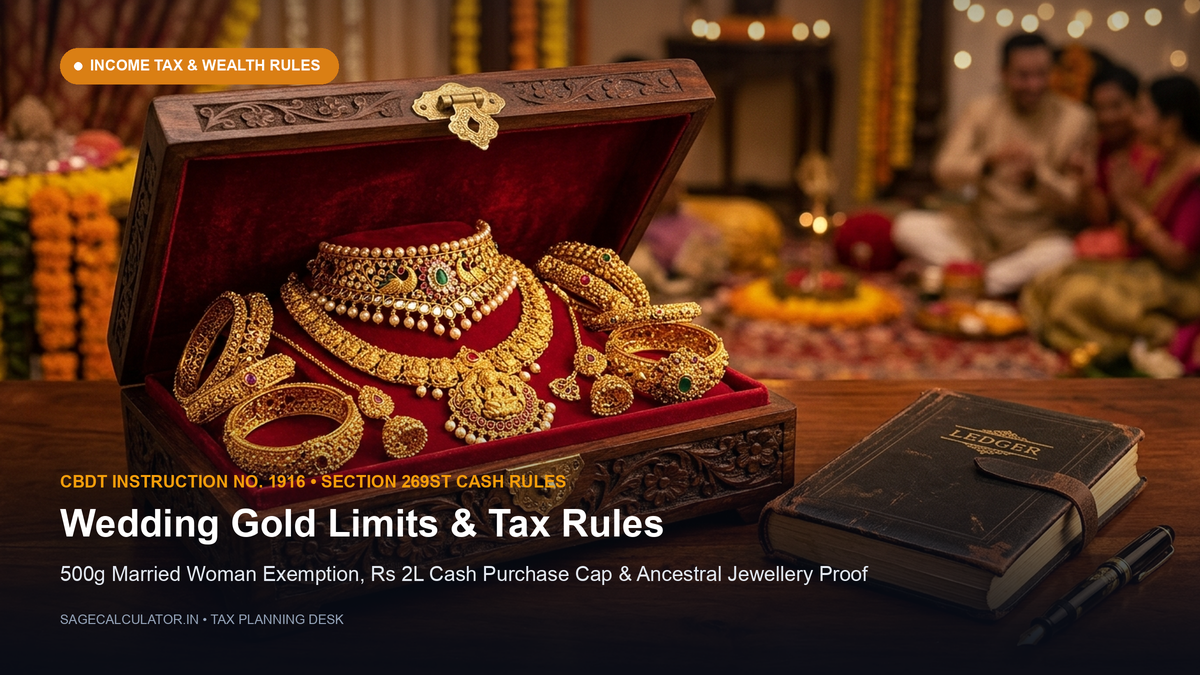
- CBDT Instruction No. 1916 grants immunity from seizure during tax search operations up to 500g for married women, 250g for unmarried women, and 100g for male family members.
- Section 269ST strictly prohibits cash transactions of ₹2,00,000 or more in a single day or for a single jewellery bill. Violators face a 100% penalty under Section 271DA.
- Streedhan is the absolute legal property of an Indian woman under Hindu Law; tax authorities cannot confiscate or question customary wedding gifts within reasonable social customs.
- Exchanging old ancestral jewellery for new hallmark jewellery does not trigger Capital Gains Tax if executed as an exchange through a licensed jeweller, but cash sales attract 12.5% LTCG.
Calculate Exact Gold Jewellery Making Charges & 3% GST
Enter current 22K/24K gold rates, jewellery weight in grams, making charge percentage, and old gold exchange credit to compute itemized GST invoices.
Debunking the Myth: Can the Income Tax Department Cap How Much Gold You Own?
As the traditional Indian wedding season gains momentum alongside record-high gold and silver bullion rates, one pervasive rumor frequently triggers panic among families: "Does the Indian government limit gold holding to 500 grams?"
The definitive legal answer is NO. Under the Income-tax Act, there is zero restriction on the maximum quantity or weight of gold bullion, coins, or jewellery an individual or Hindu Undivided Family (HUF) can hold.
You can legally own 5 kilograms or even 20 kilograms of gold jewellery, provided you can prove the source of investment—such as through past income tax returns (ITR), salary savings, agricultural income, legal inheritance (via a registered Will), or customary marriage gifts (Streedhan).
The misconception arises from CBDT Instruction No. 1916 (dated May 11, 1994), which does NOT define an ownership cap, but rather sets a mandatory non-seizure threshold below which income tax search officers are strictly forbidden from confiscating jewellery.
CBDT Instruction No. 1916: The Statutory Non-Seizure Safe Harbor Slabs
During an official search and seizure operation under Section 132 of the Income-tax Act, income tax officials are legally bound by CBDT circulars. Even if an individual possesses no invoices, receipts, or purchase bills, tax officers CANNOT seize gold jewellery up to the following statutory quotas:
| Family Member Category | Protected Gold Quota | Documentation Required | Officer Confiscation Power |
|---|---|---|---|
| Married Female (Wife / Mother) | 500 Grams (~62.5 Tolas) | No Invoices Needed | Strictly Prohibited from Seizure |
| Unmarried Female (Daughter / Sister) | 250 Grams (~31.2 Tolas) | No Invoices Needed | Strictly Prohibited from Seizure |
| Male Member (Husband / Son / Father) | 100 Grams (~12.5 Tolas) | No Invoices Needed | Strictly Prohibited from Seizure |
| Combined Family of 4 (Father, Mother, 1 Son, 1 Daughter) | 950 Grams (~118.7 Tolas) | Protected Slabs Combined | Protected as Customary Holding |
| Quantity Above Safe Harbor Slabs | Any Excess Weight | Requires Invoice / Will / Streedhan Proof | Can Be Seized if Unexplained |
The Strict ₹2 Lakh Cash Limit Under Section 269ST
While gold holding is broadly protected, the rules regarding purchasing gold with cash are exceptionally rigid.
Under Section 269ST of the Income-tax Act, no individual is permitted to receive or pay an amount of ₹2,00,000 or more in cash:
1. In aggregate from a person in a single day;
2. In respect of a single transaction; or
3. In respect of transactions relating to one event or occasion.
The 100% Penalty Trap (Section 271DA): If you purchase a bridal gold necklace worth ₹3,50,000 and pay ₹2,50,000 in cash, the jeweller faces a mandatory penalty under Section 271DA equal to 100% of the cash received (₹2,50,000).
Furthermore, under Section 139A and Rule 114B of the Income Tax Rules, quoting the customer’s Permanent Account Number (PAN) is mandatory for any sale or purchase of jewellery or bullion where the transaction value exceeds ₹2,00,000, regardless of whether paid via NEFT, UPI, credit card, or cheque.
How to Legally Protect and Document Ancestral & Inherited Jewellery
In Indian culture, a substantial portion of wedding gold is passed down across generations without formal GST retail invoices. To safeguard your ancestral assets against future tax queries, follow these four proactive measures:
1. Family Settlement Deed or Registered Will: If jewellery was inherited from grandparents or parents, maintain a certified copy of the Will or family partition deed clearly listing the jewellery items and approximate weights.
2. Government-Approved Valuer Report: Hire a certified registered valuer to inspect, weigh, and catalog all heirloom ornaments. A professional valuation report stating the purity, vintage hallmark, and replacement value serves as indisputable evidence during scrutiny.
3. Marriage Gift Declarations (Streedhan): Maintain a gift memorandum signed by close relatives for precious ornaments presented during weddings. Under Section 56(2)(x), monetary or jewellery gifts received from defined linear relatives on the occasion of marriage are 100% tax-exempt without any financial limit.
4. Bank Locker Operation Records: Maintain a clear record of when family jewellery is withdrawn from safe deposit lockers for family weddings and returned afterward.
Capital Gains Tax Rules on Exchanging or Selling Old Gold
Under the revised capital gains framework for FY 2026–27 (AY 2027–28):
• Holding Period Classification: Gold and silver jewellery held for more than 24 months is classified as a Long-Term Capital Asset. If held for 24 months or less, it is treated as a Short-Term Capital Asset.
• Long-Term Capital Gains (LTCG): Gains arising from the sale of old physical gold held for over 2 years are taxed at a flat rate of 12.5% without indexation (under Section 112).
• Pure Jewellery Exchange: If you surrender 100 grams of old 22K gold to a jeweller in exchange for 100 grams of new hallmarked jewellery and only pay the difference in making charges and 3% GST on the incremental value, jewellers treat it as a trade exchange. However, if you receive cash back for the old scrap, the cash component represents a taxable transfer.
Direct Tax Advisory Head • SageCalculator Research Desk
Frequently Asked Questions (FAQs)
Can the income tax department seize jewellery given as Streedhan to a bride?▼
No. Under traditional Hindu Law and Supreme Court precedents (Pratibha Rani v. Suraj Kumar), Streedhan is the absolute property of the woman. Income tax search officers are instructed to respect cultural and social customs and cannot seize customary Streedhan ornaments belonging to the bride within reasonable social standing.
Is PAN card mandatory for buying gold jewellery below ₹2 Lakhs in cash?▼
For transactions up to ₹1,99,999 in cash, quoting a PAN card is not legally mandatory under Rule 114B (though many large retail chains have internal policies requesting KYC). However, once the total invoice value reaches ₹2,00,000 or more, PAN submission is strictly compulsory by law.
Are wedding gifts of gold from friends taxable under the Income Tax Act?▼
Gifts received from "relatives" (parents, siblings, in-laws, maternal/paternal aunts and uncles) on the occasion of marriage are 100% exempt without any monetary limit under Section 56(2)(x). However, gifts from non-relatives or friends are exempt only if the aggregate value of all such non-relative gifts does not exceed ₹50,000 in the financial year.
Can I keep gold jewellery in a bank locker without disclosing it in my ITR?▼
You are not required to disclose personal effects or jewellery in standard ITR-1 or ITR-2 unless your total taxable income exceeds ₹50 Lakhs. If your total income exceeds ₹50 Lakhs, you must report the cost of all jewellery, bullion, and precious metals in Schedule AL (Assets and Liabilities) of your tax return.
How is the purchase cost of inherited ancestral gold calculated for capital gains?▼
Under Section 49(1) of the Income-tax Act, the cost of acquisition of inherited gold is deemed to be the cost for which the previous owner (who purchased it) acquired it. If acquired prior to April 1, 2001, the taxpayer can substitute the Fair Market Value (FMV) of the gold as on April 1, 2001 as their cost basis.