Registering a Flat in Bangalore This Festive Season? Why Kaveri 2.0 Guidance Values Are Adding ₹3.5 Lakhs in Extra Stamp Duty
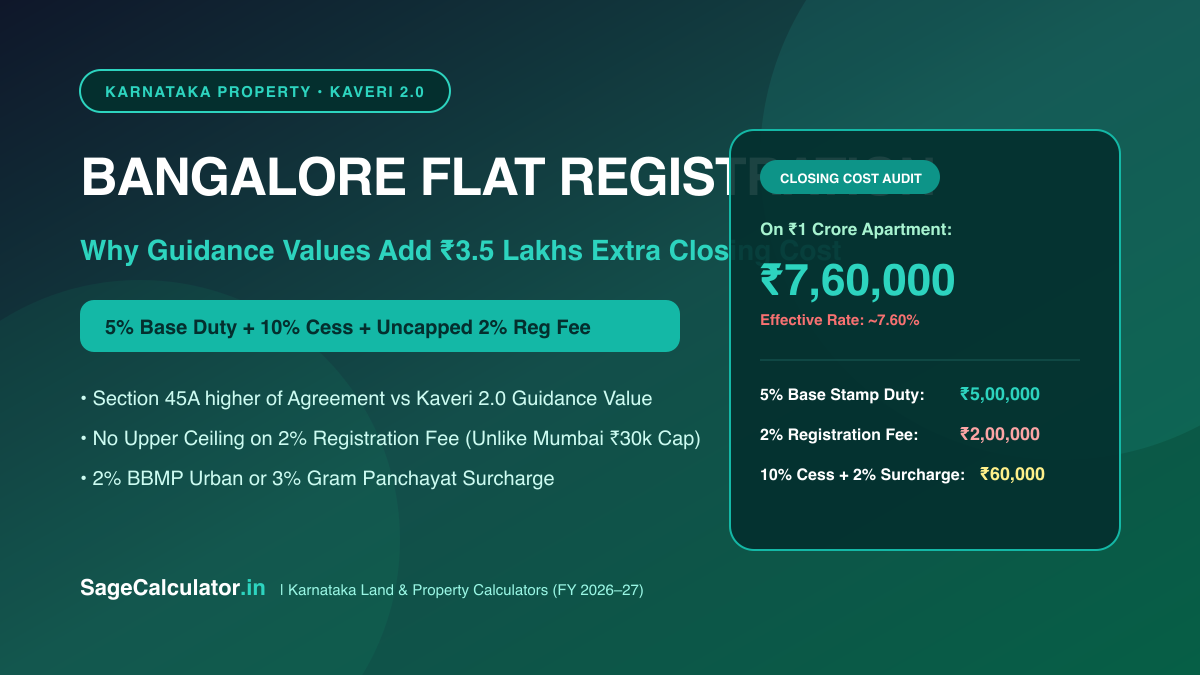
- Under Section 45A of the Karnataka Stamp Act, duty is statutorily assessed on the higher of Actual Agreement Value or Kaveri 2.0 Guidance Value.
- Properties priced above ₹45 Lakhs attract the top 5% base stamp duty, plus a 10% infrastructure cess and 2% BBMP urban surcharge.
- Unlike Maharashtra’s ₹30,000 cap, Karnataka charges a flat 2% registration fee without ANY monetary upper ceiling.
- For a ₹1.2 Crore apartment in Whitefield or Bellandur, government closing fees total over ₹8 Lakhs.
Calculate Exact Bangalore Stamp Duty & Registration Fees
Input agreement value vs Kaveri 2.0 guidance value across BBMP, BDA, and Gram Panchayat jurisdictions.
The True Cost of Registering an Apartment in Bengaluru
Bengaluru’s property market has witnessed tremendous sales velocity across corridors like Sarjapur Road, Whitefield, North Bangalore near the International Airport, and Electronic City.
However, first-time homebuyers often budget only 5% for government statutory registration, leading to severe cash-flow surprises at the Sub-Registrar office. In Karnataka, the total closing cost routinely exceeds 6.6% to 7.6% of the total property valuation.
Crucially, Karnataka does not cap registration fees. While a buyer purchasing a ₹2 Crore apartment in Mumbai pays a maximum registration fee of ₹30,000, a buyer purchasing a ₹2 Crore flat in Bangalore pays a staggering ₹4,00,000 (2%) in registration fees alone.
The 3-Tier Stamp Duty Structure & Mandatory Cesses
Under the Karnataka Stamp (Amendment) Act, stamp duty is structured across three distinct property valuation slabs:
• Slabs up to ₹20,00,000: 2% base stamp duty.
• Slabs between ₹20,00,001 and ₹45,00,000: 3% base stamp duty.
• Slabs exceeding ₹45,00,000: 5% base stamp duty.
In addition to base duty, every transaction must pay a mandatory 10% Infrastructure Cess on the stamp duty amount, plus a 2% Municipal Surcharge (within BBMP, City Corporation, and Town Municipal limits) or a 3% Rural Surcharge (under Gram Panchayat jurisdictions).
| Statutory Component | Statutory Rate / Rule | Payable Amount on ₹1 Crore Property |
|---|---|---|
| Base Stamp Duty | 5.00% (Properties > ₹45 Lakhs) | ₹5,00,000 |
| Infrastructure Cess | 10% of Base Stamp Duty | ₹50,000 |
| BBMP Urban Surcharge | 2% of Base Stamp Duty | ₹10,000 |
| Registration Fee | Flat 2.00% (No Maximum Ceiling) | ₹2,00,000 |
| Total Government Fees | Effective Rate: ~7.60% | ₹7,60,000 Total Out-of-Pocket! |
Kaveri 2.0 Guidance Value Rule: The Assessment Benchmark
Under Section 45A of the Karnataka Stamp Act, you cannot calculate duty solely on what you negotiated with the seller or developer. The Sub-Registrar evaluates the official Kaveri 2.0 Guidance Value for your specific survey number or apartment complex.
If your sale consideration is ₹90 Lakhs, but Kaveri 2.0 guidance value rates benchmark the unit at ₹1.05 Crores, stamp duty and registration fees are legally mandated to be paid on the higher ₹1.05 Crore figure. Ensure your lawyer checks the latest Kaveri 2.0 guidance rate certificate before executing your final sale deed.
Frequently Asked Questions (FAQs)
Is there any stamp duty concession for women buyers in Karnataka?▼
No. Unlike Maharashtra, Delhi, and Haryana which offer a 1% to 2% stamp duty discount for female property purchasers, Karnataka does not currently provide any gender-based concession in stamp duty or registration fees.
Are registration fees refundable if a sale deed is cancelled?▼
No. Registration charges paid to the Department of Stamps and Registration are non-refundable statutory processing fees. However, under specific legal conditions, unused e-stamp paper duty may be claimed for refund within 6 months subject to a 10% statutory deduction.
Does the buyer also have to deduct TDS on Bangalore property purchases?▼
Yes. If the property value equals or exceeds ₹50,00,000, the buyer must statutorily deduct 1% TDS under Section 194-IA of the Income Tax Act on the higher of Sale Consideration or Kaveri 2.0 Guidance Value, and remit it via Form 26QB within 30 days.