UPS vs NPS Irrevocable Choice: Why Opting for 50% Assured Pension Could Cost Market-Savvy Employees ₹42 Lakhs (Breakeven Math)
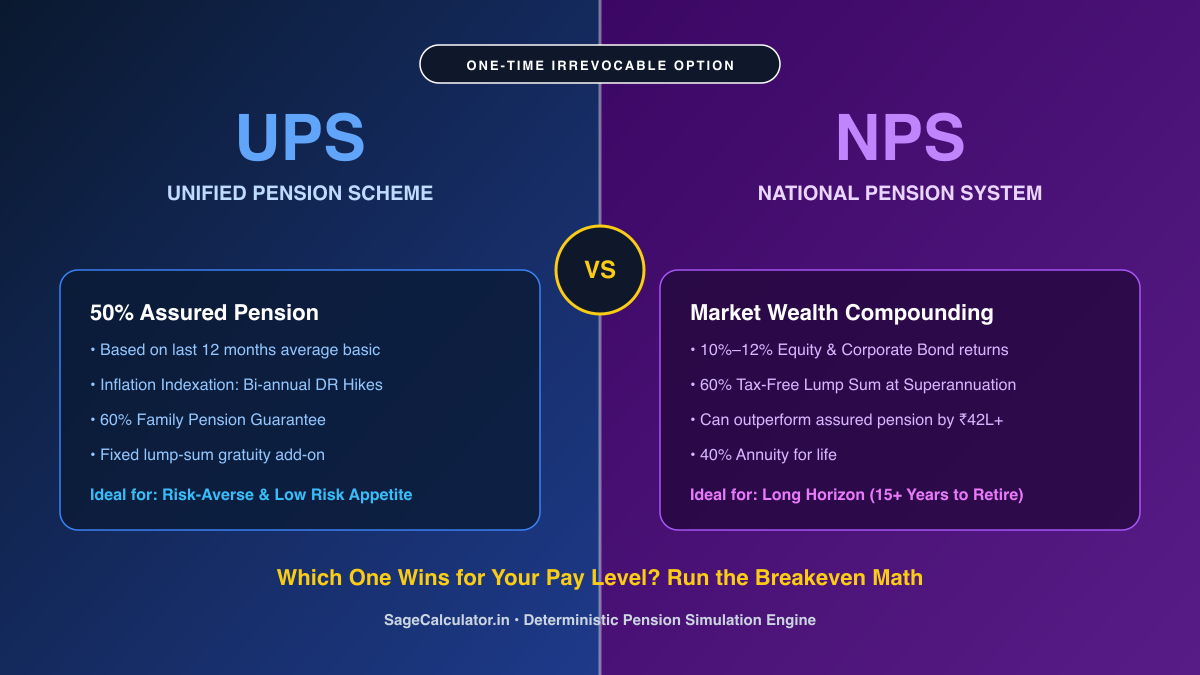
- UPS guarantees 50% of average basic pay drawn in the last 12 months for employees with 25+ years of qualifying service.
- Includes assured 60% family pension and bi-annual Dearness Relief (DR) inflation indexation matching central rates.
- NPS permits 60% tax-free lump sum withdrawal at superannuation, with the remaining 40% invested in a commercial annuity.
- Employees with 15+ years left to retirement investing aggressively in NPS Scheme E (Equity) can accumulate a corpus generating higher monthly cashflows than UPS.
Compare UPS vs NPS Breakeven for Your Pay Level
Run side-by-side simulations of UPS 50% assured pension vs NPS equity market compounding, annuity yields, and superannuation lump sums.
The Dilemma Facing 23 Lakh Central Government Employees
The Union Cabinet’s notification of the Unified Pension Scheme (UPS)—effective April 1, 2025—marked a historic compromise in Indian pension reform. It re-introduced the security of a defined benefit pension while retaining the fiscal sustainability of a contributory architecture.
However, the critical clause in the gazette notification is that switching from NPS to UPS is an IRREVOCABLE, one-time decision. Once an employee opts for UPS, they can never return to NPS.
This has created a intense mathematical debate across government departments: Should you take the guaranteed 50% pension with government DR indexation, or stay in NPS to harvest long-term market compounding?
Head-to-Head Architectural Comparison
To make an informed decision, employees must understand the structural mechanics of both schemes:
| Parameter | Unified Pension Scheme (UPS) | National Pension System (NPS) |
|---|---|---|
| Employee Contribution | 10% of (Basic + DA) | 10% of (Basic + DA) |
| Government Contribution | 18.5% (Enhanced from 14%) | 14.0% of (Basic + DA) |
| Pension Guarantee | 50% of last 12-month basic (25+ yrs service) | Zero guarantee (Market yield dependent) |
| Inflation Indexation | Full Dearness Relief (DR) bi-annually | Zero DR (Fixed commercial annuity payout) |
| Minimum Monthly Pension | ₹10,000 / month (10+ yrs service) | No minimum floor |
| Family Pension | 60% of employee pension upon demise | Depends on annuity option selected |
| Lump Sum at Retirement | 1/10th basic+DA per 6 months service | 60% of total accumulated corpus (100% Tax-Free) |
The Breakeven Math: Who Wins Where?
Scenario A (The UPS Winner): An employee with less than 10–12 years of remaining service, or one who allocated primarily to conservative NPS debt funds (Scheme G), will almost always win under UPS. The sovereign guarantee of 50% basic pay combined with bi-annual Dearness Relief protects against inflation without market volatility risk.
Scenario B (The NPS Winner): A young officer entering service at age 25 with 30–35 years to retirement who allocates 50%–75% of their NPS contribution to Scheme E (Equity). Over 30 years at a conservative 11% CAGR, the NPS corpus grows to over ₹4.5 Crores. Withdrawing ₹2.7 Crores tax-free and investing ₹1.8 Crores in senior debt generates higher monthly income than the UPS basic pension, while preserving crores in generational family capital.
Frequently Asked Questions (FAQs)
Can state government employees also opt for UPS?▼
Yes. State governments (including Maharashtra and others) have announced adoption of the UPS framework for state civil servants under matching contribution rules.
What happens if an employee has completed between 10 and 24 years of service?▼
UPS provides a proportionate pension for employees with between 10 and 24 years of service, subject to the statutory minimum guaranteed floor of ₹10,000 per month.
Is the 60% family pension in UPS also indexed with Dearness Relief?▼
Yes. The 60% family pension granted to the surviving spouse carries full Dearness Relief (DR) indexation matching central government rates.