8th Pay Commission Basic Pay Matrix: NC-JCM’s 3.83x Demand (₹69,000) vs 2.28x Economic Baseline (₹34,560) & The 60% DA Reset Math
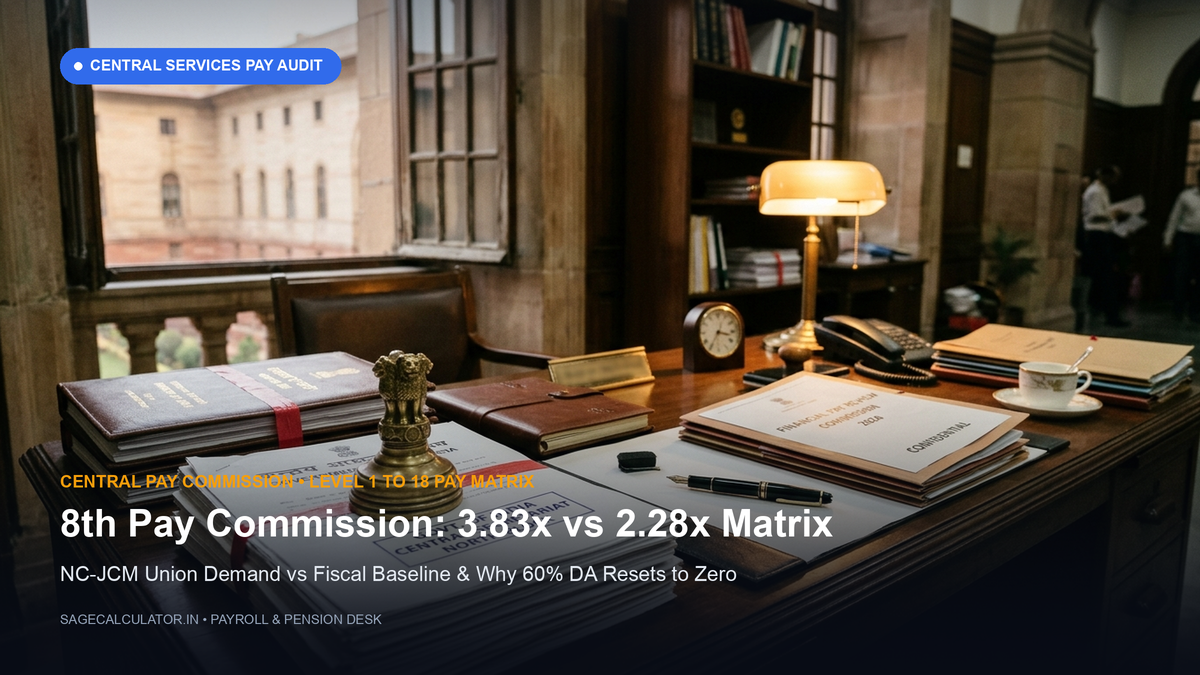
- The 8th Central Pay Commission (headed by Justice Ranjana Prakash Desai) is actively holding nationwide consultations with central government employee unions, defence federations, and pensioner bodies.
- Union Demand (3.83x Multiplier): The Staff Side of the National Council-Joint Consultative Machinery (NC-JCM) has formally demanded raising entry-level Basic Pay (Level 1) from ₹18,000 to ₹69,000 using a 3.83x multiplier.
- Fiscal Deficit Reality (2.28x to 2.46x): Economic analysts project that keeping fiscal deficit targets under control will likely lead to an adopted fitment factor of 2.28x to 2.57x, yielding a Level 1 Basic Pay between ₹34,560 and ₹46,260.
- The 60% DA Reset Rule: Under Central Civil Services (CCS) revised pay mechanics, the accumulated 60% Dearness Allowance (DA) is merged into revised basic pay, resetting the official DA rate back to 0% on implementation.
- Pay Matrix Level 1 to 18 Impact: Check the projected pay matrix across Group C, Group B Gazetted, and Senior Group A Joint Secretary / Cabinet Secretary levels.
Model Your 8th CPC Salary & Fitment Multiplier
Estimate revised Basic Pay, DA, HRA, and monthly Take-Home salary across fitment factors from 1.83x to 4.0x.
Nationwide Consultations Underway for 1.1 Crore Employees & Pensioners
With nearly 48 lakh central government employees and over 68 lakh pensioners across India, the constitution and proceedings of the 8th Central Pay Commission represent the single largest compensation event in the Indian public sector.
The panel, constituted under the chairmanship of former Supreme Court Judge Justice Ranjana Prakash Desai, is conducting extensive interaction tours across Delhi, Bengaluru, Mumbai, and state capitals, gathering representations from civil services, railway federations, and defence pensioner associations.
The core debate centers around a single mathematical multiplier: the **Fitment Factor**—which determines how existing 7th CPC basic pay figures will be multiplied into the new 8th CPC pay matrix.
NC-JCM Demand (3.83x) vs Government Economic Projections (2.28x)
To understand the spectrum of potential pay revisions, consider the two competing schools of thought:
• Staff Side NC-JCM Demand (3.83x Multiplier): Employee federations cite the 15th Indian Labour Conference (ILC) Dr. Wallace Aykroyd nutritional norms, accounting for escalating housing, health, and children education costs. A 3.83x multiplier would raise the minimum basic salary (Pay Level 1) from ₹18,000 to approximately ₹69,000 per month.
• Ministry of Finance Fiscal Baseline (2.28x to 2.57x Multiplier): Economic advisers highlight that an excessive multiplier would balloon the central government wage bill, impacting fiscal deficit targets. A moderate multiplier between 2.28x (matching the 7th CPC base minus DA) and 2.57x (the exact fitment multiplier adopted under 7th CPC) would establish minimum basic pay between ₹34,560 and ₹46,260.
| Pay Matrix Level & Typical Post | 7th CPC Basic Pay | Conservative 2.28x | Middle Ground 2.86x | Union Demand 3.83x |
|---|---|---|---|---|
| Level 1 (MTS / Group C Entry) | ₹18,000 | ₹41,040 | ₹51,480 | ₹68,940 |
| Level 2 (LDC / Junior Clerk) | ₹19,900 | ₹45,372 | ₹56,914 | ₹76,217 |
| Level 4 (UDC / Data Entry Op) | ₹25,500 | ₹58,140 | ₹72,930 | ₹97,665 |
| Level 6 (Sub-Inspector / Asst Section Off) | ₹35,400 | ₹80,712 | ₹1,01,244 | ₹1,35,582 |
| Level 7 (Inspector / Section Officer) | ₹44,900 | ₹1,02,372 | ₹1,28,414 | ₹1,71,967 |
| Level 10 (UPSC Civil Services Entry / SDM) | ₹56,100 | ₹1,27,908 | ₹1,60,446 | ₹2,14,863 |
| Level 14 (Joint Secretary to GoI) | ₹1,44,200 | ₹3,28,776 | ₹4,12,412 | ₹5,52,286 |
| Level 18 (Cabinet Secretary of India) | ₹2,50,000 | ₹5,70,000 | ₹7,15,000 | ₹9,57,500 |
Why Accumulated 60% DA Resets to Zero Upon Implementation
A frequent point of confusion among central government staff is what happens to their accumulated Dearness Allowance (DA). Under 7th CPC, DA has climbed to 60% of basic pay following successive bi-annual hikes.
When the 8th Pay Commission recommendations are officially notified:
1. Full DA Absorption: The entire 60% DA is mathematically absorbed into the new basic pay structure via the fitment factor.
2. The Zero Reset: Because the new basic pay reflects current living costs, the Dearness Allowance rate resets back to 0% on the implementation date.
3. Subsequent Increments: Starting from the zero baseline, future DA hikes will be calculated bi-annually based on the 12-month average of the All India Consumer Price Index for Industrial Workers (AICPI-IW) linked to the new base year.
Timeline & Implementation Arrears Roadmap
The 8th Central Pay Commission was formally constituted with an 18-month timeline to submit its comprehensive report to the Union Cabinet. Key milestones include:
• Stakeholder Submissions: Concluding union presentations and defence representations.
• Report Tabled: The Commission is scheduled to submit its final report to the Ministry of Finance around May 2027.
• Retrospective Implementation: Pay commissions are traditionally implemented with retrospective effect from January 1 of the implementation year (e.g., 1 January 2026), meaning central employees will receive substantial lump-sum arrears for the intervening period once notified!
Central Services Editorial Lead • SageCalculator Research Desk
Frequently Asked Questions (FAQs)
Will pensioners benefit from the 8th Pay Commission fitment factor?▼
Yes! All 68+ lakh central pensioners will have their basic pensions revised using the exact same fitment multiplier applied to serving employees. Furthermore, pensioners will enjoy higher family pensions and commuted pension value revisions.
How does the 8th CPC fitment factor affect House Rent Allowance (HRA)?▼
HRA rates are traditionally restructured when new pay commission scales take effect. Under 7th CPC, HRA was set at 24%, 16%, and 8% for X, Y, and Z cities, rising to 30%, 20%, and 10% as DA crossed 50%. The 8th CPC will re-anchor HRA percentages to revised basic pay scales.
What was the fitment factor used in previous Pay Commissions?▼
Historical fitment factors were: 5th Pay Commission (3.06x), 6th Pay Commission (1.86x band pay multiplier with separate grade pay), and 7th Pay Commission (2.57x across pay matrix Level 1 to 18).
Does the 8th Pay Commission apply to State Government employees?▼
While the Central Pay Commission applies directly to Central Government employees, defence personnel, and Union Territories, most State Governments (e.g., Maharashtra, Karnataka, UP, Bihar) adopt the Central Pay Commission pay matrix with state-specific modifications within 6 to 18 months.