Dearness Relief (DR) Hike for Central Govt Pensioners: Why DR Is Calculated on 100% Original Pension Even After 40% Commutation
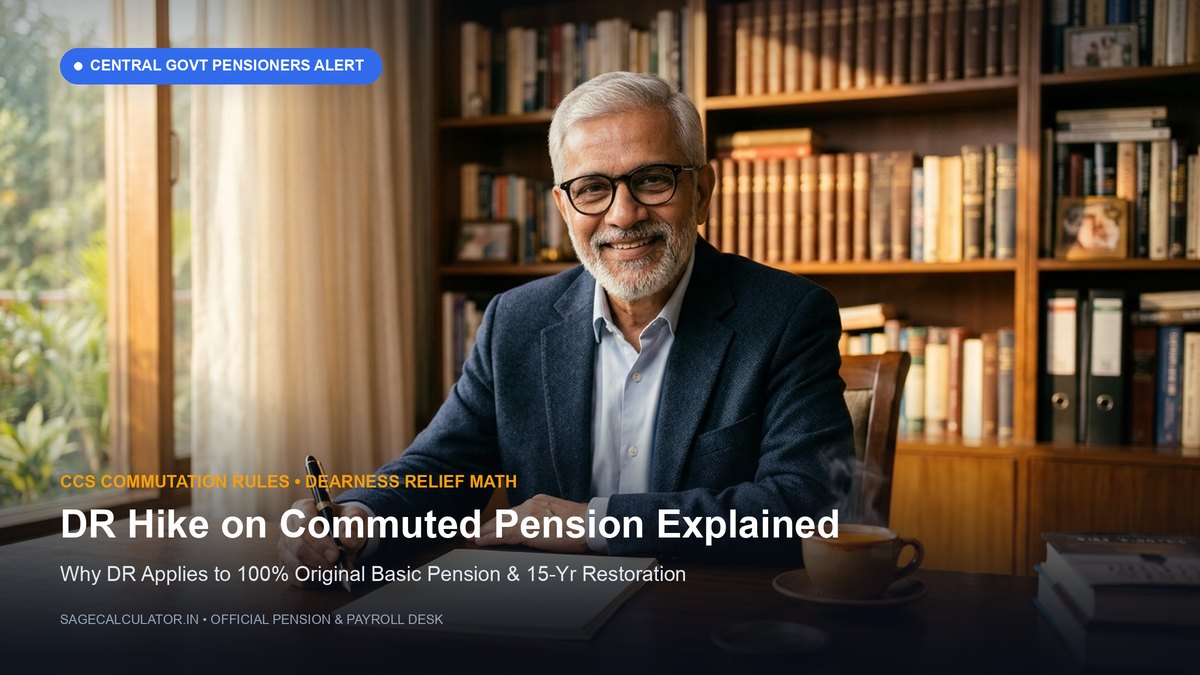
- Statutory Rule: Even if you commuted the maximum 40% of your basic pension at retirement for a tax-free lump sum, your Dearness Relief (DR) is computed on 100% of your Original Uncommuted Basic Pension.
- A 3% DR hike on a ₹40,000 Original Basic Pension increases your monthly bank credit by the full ₹1,200/month (not ₹720/month), plus ₹3,600 in 3-month arrears.
- If a pensioner passes away during the 15-year commutation recovery window, the 40% commutation deduction stops immediately—Family Pension is paid without any commutation deduction.
- Under Rule 10A of CCS (Commutation of Pension) Rules, the 40% commuted portion is automatically restored after 15 years (180 months) from the date of credit of the commuted lump sum.
Calculate Your Commuted Lump Sum, Monthly Pension + DR & Restoration Date
Enter your retiring Basic Pay and commutation percentage (up to 40%) to compute your tax-free lump sum, exact monthly bank pension with DR, and 15-year vs 12-year restoration savings.
The Golden Rule of Commuted Pension: Why DR Always Applies to 100% Original Basic Pension
When a Central Government civil employee or Defence personnel retires on superannuation at Age 60, the Central Civil Services (Commutation of Pension) Rules permit commuting up to 40% of Basic Pension into an upfront, 100% tax-free lump sum using the official commutation factor (8.194 at Age 60 next birthday).
For example, if your retiring Basic Pay is ₹80,000, your Original Basic Pension (50%) is ₹40,000/month. Commuting 40% (₹16,000/month) gives you an instant tax-free lump sum of ₹16,000 × 12 × 8.194 = ₹15,73,248, while your residual basic pension drops to ₹24,000/month for 15 years.
Here is the crucial statutory rule under Rule 55-A of the CCS (Pension) Rules, 2021: Dearness Relief (DR) is ALWAYS calculated on the Original Basic Pension (₹40,000), NEVER on the reduced residual pension (₹24,000)!
Consequently, every 3% Dearness Relief hike adds 3% × ₹40,000 = ₹1,200/month to your monthly pension credit—giving you the exact same rupee DR increase as a retiree who commuted 0% of their pension.
| Original Basic Pension (50% of Last Pay) | 40% Commuted Deduction (For 15 Yrs) | Residual Basic Pension (60%) | Monthly Gain from 3% DR Hike (On 100% Basic) | Monthly Net Pension at 53% → 56% DR |
|---|---|---|---|---|
| ₹25,000 / mo | −₹10,000 / mo | ₹15,000 / mo | +₹750 / mo (₹2,250 3-Mo Arrear) | ₹28,250 → ₹29,000 / mo |
| ₹40,000 / mo | −₹16,000 / mo | ₹24,000 / mo | +₹1,200 / mo (₹3,600 3-Mo Arrear) | ₹45,200 → ₹46,400 / mo |
| ₹55,000 / mo | −₹22,000 / mo | ₹33,000 / mo | +₹1,650 / mo (₹4,950 3-Mo Arrear) | ₹62,150 → ₹63,800 / mo |
| ₹75,000 / mo | −₹30,000 / mo | ₹45,000 / mo | +₹2,250 / mo (₹6,750 3-Mo Arrear) | ₹84,750 → ₹87,000 / mo |
How the DR Hike Impacts Enhanced (50%) and Ordinary (30%) Family Pensioners
For family pensioners receiving pension after the demise of a government servant or retiree, two powerful statutory protections apply:
1. Zero Commutation Recovery From Family Pension: Even if the deceased pensioner had commuted 40% of their pension and passed away only 4 years after retirement, the remaining 11 years of commutation recovery are 100% waived off. Family pension is paid in full without deducting a single rupee toward the commuted lump sum.
2. Full DR on Family Pension: During the first 7 years (or until the deceased would have turned 67), Enhanced Family Pension is paid at 50% of last Basic Pay plus full Dearness Relief. Thereafter, Ordinary Family Pension is paid at 30% of last Basic Pay plus full Dearness Relief.
Age-Linked Additional Quantum of Pension (Age 80 to 100+): Does DR Apply to the Extra 20%?
Yes! Under Section 44(6) of the CCS (Pension) Rules, 2021, senior pensioners receive an automatic "Additional Quantum of Pension / Family Pension" starting from the first day of the month in which they enter their 80th year (i.e., on completing 80 years of age):
• 80 to <85 Years: +20% of Basic Pension
• 85 to <90 Years: +30% of Basic Pension
• 90 to <95 Years: +40% of Basic Pension
• 95 to <100 Years: +50% of Basic Pension
• 100 Years & Above: +100% of Basic Pension
Crucially, Dearness Relief (DR) is payable on BOTH the Original Basic Pension AND the Additional Pension Quantum! Thus, for an 80-year-old pensioner with ₹40,000 basic pension (+₹8,000 additional pension = ₹48,000), a 3% DR hike adds ₹1,440/month instead of ₹1,200/month.
The 15-Year vs 12-Year Commutation Restoration Debate Before the 8th Pay Commission
Under existing Rule 10A, the 40% commuted pension is restored after 15 years (180 months) from the date the lump-sum commutation value is credited. However, because the 7th CPC commutation factor at Age 60 is 8.194 (meaning the principal lump sum equals 8.194 × 12 = 98.33 months of commuted pension), the government recovers the principal in just 8.2 years and collects an implicit ~8.9% interest over the remaining 6.8 years.
With the 5th CPC and multiple State Pay Commissions (including Kerala, Gujarat, and Punjab cases) recommending restoration at 12 years (144 months), the National Council (JCM) Staff Side has formally placed 12-year restoration on the agenda of the 8th Central Pay Commission—which would save a retiring Level-10 officer ₹5,76,000 in 36 months of early restoration.
Frequently Asked Questions (FAQs)
Is the 40% commuted pension lump sum received at retirement taxable?▼
For Central Government, State Government, Defence, and PSU employees, 100% of the commuted pension lump sum received at retirement is completely exempt from Income Tax under Section 10(10A)(i) of the Income Tax Act, 1961—under both the Old and New Tax Regimes.
Do I have to submit an application to my bank or CPAO after 15 years to restore my commuted pension?▼
Under updated CPAO / SPARSH automated pension disbursement systems, restoration after 180 months from the date of credit of the commuted value is processed automatically. However, pensioners holding older manual PPOs with commercial banks are advised to submit a simple restoration intimation letter 1 month prior to completing 15 years.
From which exact date is the 15-year restoration period counted if my commutation lump sum was paid 3 months after retirement?▼
Under Rule 10A of the CCS (Commutation of Pension) Rules, the 15-year (180-month) countdown starts from the actual date on which the commuted value is credited to your bank account (when the reduction in monthly pension begins), not necessarily the date of superannuation.
Are 6th CPC pensioners who opted not to switch to the 7th CPC matrix also getting a DA/DR hike?▼
Yes. The Department of Expenditure issues a separate Office Memorandum revising Dearness Allowance / Dearness Relief for employees and pensioners continuing in the pre-revised 6th Central Pay Commission pay bands and grade pay.